
Illinois Trial Court Structure
Illinois uses a three-tier judicial branch. The Supreme Court of Illinois sits at the top as the court of last resort and the administrative head of the state's courts. Below it sits the Illinois Appellate Court, which is split into five districts. At the trial level, every county is part of a Circuit Court system that handles the day-to-day work of hearing cases. The Illinois Courts public information page explains that a person typically has a right to one appeal from a circuit court decision and may then petition the Supreme Court.
Trial work happens in the Circuit Court. The Illinois Courts case flow overview walks through how a matter moves from filing through judgment to appeal. 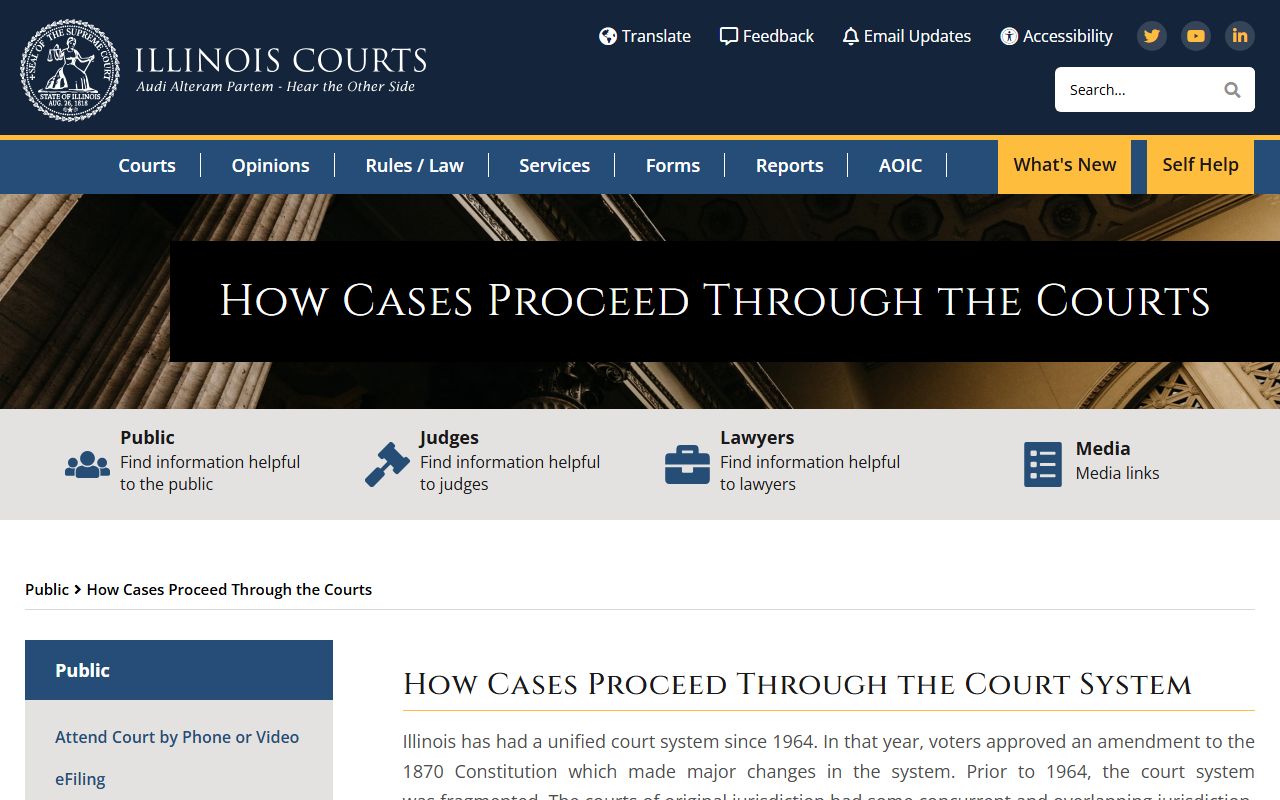 The page shows the same three-step path that a St. Clair County Circuit Court case follows: trial court, then appellate court, then possible Supreme Court review.
There is no separate county-level trial court that sits below the Circuit Court for general case work. Some local matters, such as ordinance violations or local traffic citations, are still filed within the Circuit Court system under the right case code. The Circuit Court is the floor of the state court system for trial-level case files in St. Clair County.
St. Clair as a Single-County Circuit
Illinois has 25 judicial circuits. Some of those circuits span several counties, but a few are made up of just one. The Illinois Courts Circuit Court page notes that some counties are single-county circuits, and St. Clair is one of them. The whole county sits inside the 20th Judicial Circuit, and the 20th Judicial Circuit covers only St. Clair County for trial-court purposes.
A single-county circuit setup means a few things in plain terms. Case records are not spread out across other counties. The chief judge, the assignment judges, and the elected Circuit Clerk all serve one county. A litigant who needs to track court dates, hearings, or filings looks at one circuit, one clerk, and one courthouse. That keeps the trail short for record researchers and for parties who file in person.
Court funding and staffing also follow this single-county pattern. The county budget covers Circuit Clerk staff, the State's Attorney, the Public Defender, court services, and the courthouse itself. The local 20th Judicial Circuit court services office runs adult probation, juvenile probation, and the juvenile detention center for the county.
Why This Page Is Not a District Court
Many states use the name District Court for their main trial court. Illinois does not. Illinois uses Circuit Court as the trial court name. So a search for a St. Clair County District Court file is, in plain terms, a search for a Circuit Court file under another label. The correct office is the St. Clair County Circuit Court, and the correct clerk is the St. Clair County Circuit Clerk.
People who land here from other states often type District Court out of habit. That is fine as a search term, but the case file, the case number, the case codes, and the local court rules all run through the Circuit Court system. Anyone asking for a state trial court file in St. Clair County, Illinois will be pointed to the Circuit Clerk at 10 Public Square in Belleville.
One more note on names. There is a federal court that uses a district label in its title: the United States District Court for the Southern District of Illinois. That is a different court for a different set of cases. The federal court hears federal-law cases, not the state-law civil, criminal, family, traffic, or probate cases that fill the local Circuit Court docket.
Note: The state trial court for St. Clair County is the Circuit Court; Illinois does not use a separate county-level District Court for state trial cases.
Case Categories Heard in the Circuit Court
The St. Clair County Circuit Court hears the full range of trial-level cases. The Circuit Clerk keeps a list of case codes used to mark each filing. Each code maps to a case category set by Illinois Supreme Court rules. The table below covers the most common codes a public user will run into when reading a docket sheet or pulling a file.
| Case Code | Type | Brief Description |
|---|---|---|
| CF | Criminal Felony | Any case where at least one count is a felony under the Unified Code of Corrections. |
| CM | Criminal Misdemeanor | Class A, B, or C misdemeanor cases with less than one year of possible jail time. |
| DT | DUI | Driving under the influence under the Illinois Vehicle Code, plus related boat or snowmobile statutes. |
| DV | Domestic Violence | Domestic battery cases under the Criminal Code. |
| TR | Minor Traffic | Traffic and local ordinance matters under Supreme Court Rule 501. |
| MT | Major Traffic | Major traffic cases under Rule 501, not counting DUI. |
| OV | Ordinance Violation | Local ordinance cases that are filed through the Circuit Court. |
| OP | Order of Protection | Petitions for order of protection, stalking no contact, firearms restraining, or civil no contact. |
| DC | Dissolution With Children | Divorce, civil union dissolution, invalidity, or legal separation when minor children are involved. |
| DN | Dissolution No Children | The same filings when no minor children are involved. |
| PR | Probate | Estates of decedents and missing persons under the Probate Act. |
| GR | Guardianship | Guardianship of a minor, a disabled person, or an estate. |
| SC | Small Claims | Civil tort or contract money cases up to $10,000 under Supreme Court Rule 281. |
| EV | Eviction | Residential or commercial eviction and ejectment cases. |
Other codes show up too. LA and LM mark larger and smaller money damage cases. CH covers chancery and equity matters. FC marks foreclosure cases. AD marks adoption files, which are confidential by statute. JA, JD, and JV cover juvenile abuse and neglect, delinquency, and other Juvenile Court Act matters. MR is a catch-all for miscellaneous remedy cases, and MX covers warrants, grand jury matters, expungement petitions filed without a parent case, and other criminal-process filings.
Civil, Family, Criminal, and Traffic in One Court
The Circuit Court in St. Clair County is one court that handles many subjects. There is no separate county civil court, no separate county criminal court, and no separate county traffic court at the trial level. Instead, the same Circuit Court hears all of these case types and tracks them by case code. A judge may be assigned to civil work one term and family work the next. The clerk keeps each case in the right category under the right code.
This unified setup is part of the Illinois Constitution. The state moved to a single-tier trial court system years ago. So in St. Clair County, civil law cases, small claims, evictions, family cases, probate, mental health, juvenile cases, traffic cases, and criminal cases are all handled in the same Circuit Court system. The case file lives with the Circuit Clerk. Hearings are set on the daily court docket and pulled from the same case-management system.
That matters for searching. A person looking for a divorce file in St. Clair County does not need a separate Family Court. A person looking for a probate file does not need a separate Probate Court office. The probate division is part of the Circuit Court. The same is true for juvenile, mental health, and traffic divisions.
- Civil division work covers law (LA, LM), chancery (CH), arbitration (AR), foreclosure (FC), eviction (EV), small claims (SC), and tax (TX) cases.
- Criminal division work covers felony (CF), misdemeanor (CM), DUI (DT), domestic battery (DV), and miscellaneous criminal (MX) cases.
- Family division work covers dissolution (DC, DN), parent-child cases (FA), and adoption (AD).
- Probate division work covers estates (PR) and guardianship (GR), plus mental health hospitalization (MH) matters.
- Juvenile division work covers abuse and neglect (JA), delinquency (JD), and other Juvenile Court Act matters (JV).
- Traffic division work covers minor traffic (TR), major traffic (MT), and ordinance violation (OV) cases.
The Courthouse and Public Offices
The St. Clair County Courthouse sits on the Public Square in downtown Belleville. It is the home of the Circuit Court, the Circuit Clerk, the County Clerk, the State's Attorney, and public-facing court services. A person who needs to pull a case file, pay a court fee, file in person, or get a certified copy goes to this address.
St. Clair County Courthouse
10 Public Square
Belleville, IL 62220
(618) 277-6600
Circuit Clerk: Mon-Fri 8:00 a.m. - 4:30 p.m.
County Clerk: Mon-Fri 8:30 a.m. - 5:00 p.m.
Criminal cashier booth: Mon-Fri 8:15 a.m. - 4:00 p.m.
Each office has its own counter and its own hours. The Circuit Clerk keeps the court case file, takes court payments, and runs eFiling. The County Clerk handles marriage licenses, vital records, elections, and tax-redemption searches. The State's Attorney's office handles prosecution and victim services for criminal cases. Going to the right counter saves a trip.
Appeals to the Fifth Appellate District
An appeal from the St. Clair County Circuit Court goes to the Illinois Appellate Court, Fifth District. The Fifth District meets in Mount Vernon and covers the southern counties of the state. A losing party in a civil, criminal, family, or probate case generally has a right to appeal under Illinois law, with some narrow exceptions where the appeal goes straight to the Supreme Court.
The Illinois Courts Appellate Court overview page explains the five-district setup and how the right to appeal works.  The page shows the same Fifth District that hears every appeal that leaves the St. Clair County Circuit Court.
An appeal does not retry the case. The appellate court reviews the trial record, written briefs, and oral argument to decide if legal error occurred. The court may affirm, reverse, remand for new trial, or modify the lower court's order. After that, a further petition for leave to appeal to the Illinois Supreme Court is the next step, though the Supreme Court accepts only a small share of those petitions.
Court Services and Probation
The Circuit Court relies on the 20th Judicial Circuit Court Services and Probation department for adult probation, juvenile probation, drug testing, court investigations, DNA collection, and juvenile detention. Court Services is a part of the local court structure even though the offices sit at different addresses around Belleville.
The county's Probation and Court Services page lists the three main facilities and gives the mission statement of the department. 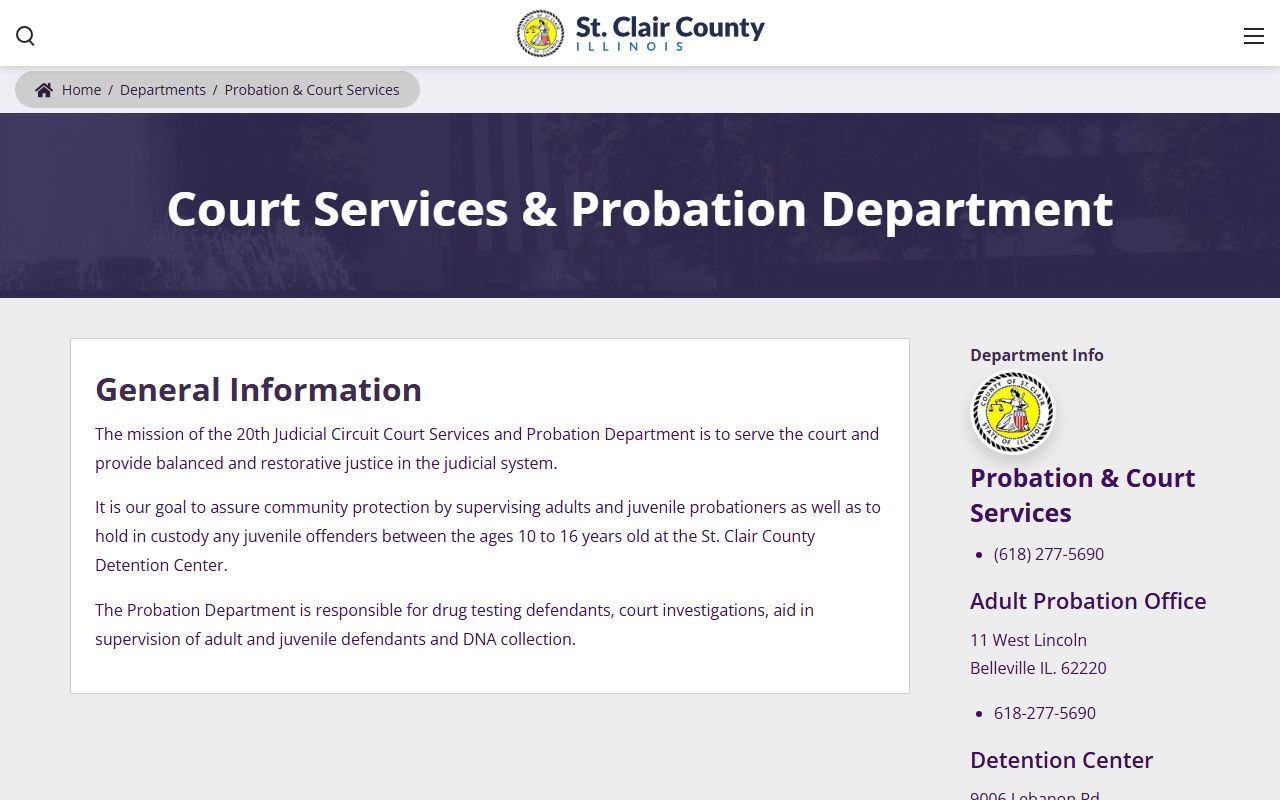 The page lists adult probation, juvenile probation, and the detention center for the 20th Judicial Circuit.
Adult Probation
11 West Lincoln
Belleville, IL 62220
(618) 277-5690
Juvenile Probation
9002 Lebanon Rd.
Belleville, IL 62223
(618) 394-1195
Juvenile Detention Center
9006 Lebanon Rd.
Belleville, IL 62223
(618) 397-9546
A judge in a criminal case may sentence a defendant to probation under adult court services supervision. A juvenile case may route a minor to juvenile probation or to the detention center under court order. These offices write court reports, take drug tests, and report violations back to the assigned judge.
Circuit Court Compared to Other Offices
It helps to compare the Circuit Court with the offices that often get confused with it. The Circuit Court is one court with broad trial jurisdiction. The County Clerk is a separate office for vital records and elections. The federal courts that sit in East St. Louis handle a different class of cases entirely. The table below sets the three side by side.
| Feature | St. Clair County Circuit Court | St. Clair County Clerk | Federal Courts (Southern District of Illinois) |
|---|---|---|---|
| Type of office | State trial court | County executive office | Federal trial and bankruptcy courts |
| What it hears or holds | Civil, criminal, family, probate, juvenile, traffic cases | Marriage records, vital records, elections, tax redemption | Federal civil, federal criminal, and bankruptcy cases |
| Clerk of record | Circuit Clerk | County Clerk | Clerk of the U.S. District Court or U.S. Bankruptcy Court |
| Records search | Circuit Clerk Court Record Search | County Clerk vital records and DevNet tax redemption | PACER federal case access |
| Public location | 10 Public Square, Belleville | 10 Public Square, Belleville | U.S. Courthouse in East St. Louis |
| Governing law | Illinois Compiled Statutes and Supreme Court Rules | Illinois county-officer statutes | Federal statutes and federal court rules |
A common error is to file a vital-records request with the Circuit Clerk or a court records request with the County Clerk. The two offices share an address but track different records. A second common error is to look for a state criminal case file in PACER. State cases do not show up in the federal system at all.
How a Case Moves Through the System
A St. Clair County Circuit Court case follows a fairly standard path. The exact steps vary by case type. A small claims case is short. A felony case can take many months and many hearings. The numbered flow below shows the main steps for a typical civil or criminal matter that starts in the Circuit Court.
- Filing: A complaint, petition, information, or indictment is filed with the Circuit Clerk and given a case number with year, case code, and sequence.
- Initial hearing: The court holds a first appearance, arraignment, or status hearing, depending on the case type, and sets future dates.
- Discovery and motions: Parties exchange evidence and file motions on issues such as suppression, summary judgment, bond, or temporary relief.
- Pretrial conferences: The judge holds status calls and may push parties toward settlement, plea, or a trial date.
- Trial or plea: The case is tried before a judge or jury, or it is resolved by plea, settlement, or default.
- Judgment: The court enters a final judgment, sentence, dissolution decree, or other final order in the case file.
- Post-judgment: Parties may file motions to reconsider, enforce, or modify, and the Circuit Clerk dockets each filing.
- Appeal: A timely notice of appeal sends the case to the Illinois Appellate Court, Fifth District in Mount Vernon.
- Further review: A party may file a petition for leave to appeal to the Illinois Supreme Court after the appellate court rules.
The Circuit Clerk dockets every step, and that docket is what the public sees on the court record search. The full record stays in the case file. To get copies of pleadings or orders, the public uses the Circuit Clerk Copy Request flow and pays the copy fees set by the office.
Federal Courts Serving St. Clair County
Federal cases that arise in St. Clair County are not heard in the Circuit Court. They live in the federal Southern District of Illinois system. The U.S. District Court for the Southern District of Illinois is the federal trial court. 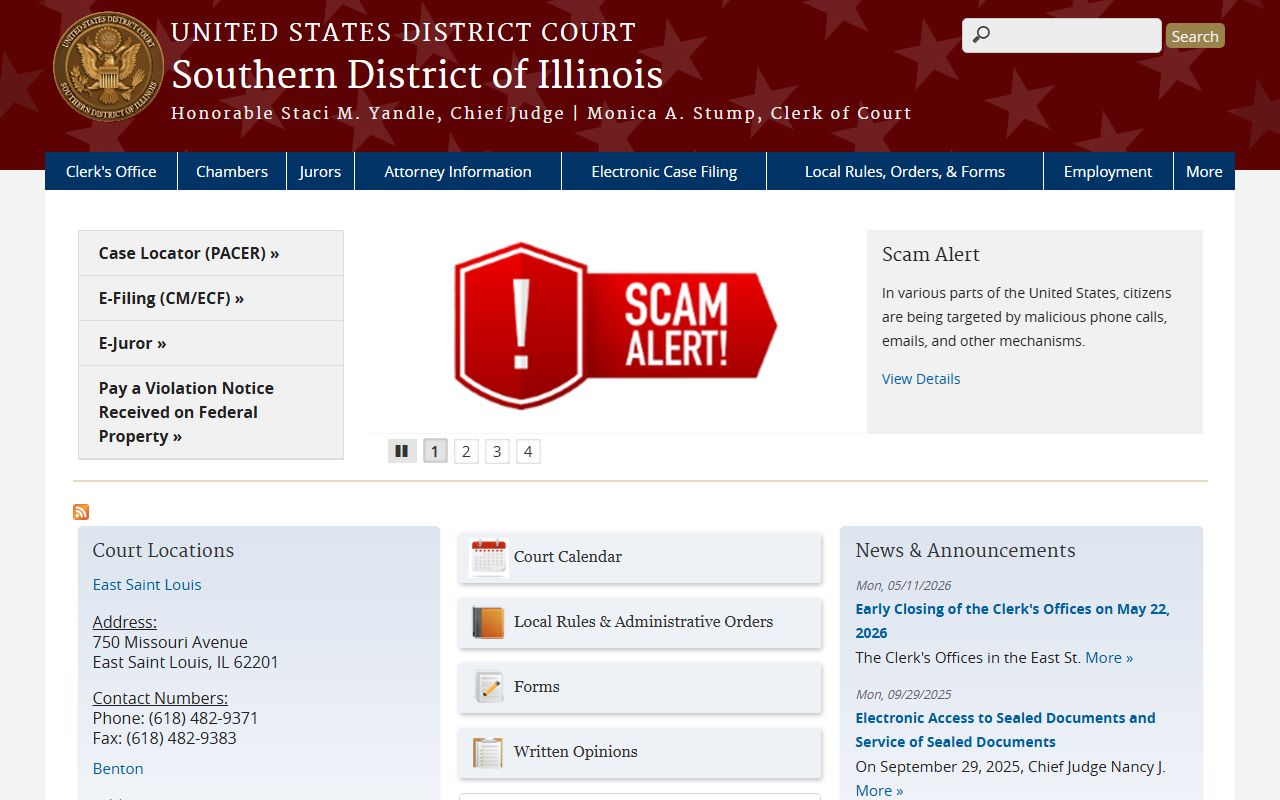 The District Court page is the entry point for federal civil and criminal filings tied to the county.
Federal bankruptcy filings go to a separate federal court. The U.S. Bankruptcy Court for the Southern District of Illinois handles Chapter 7, 11, 12, and 13 cases. 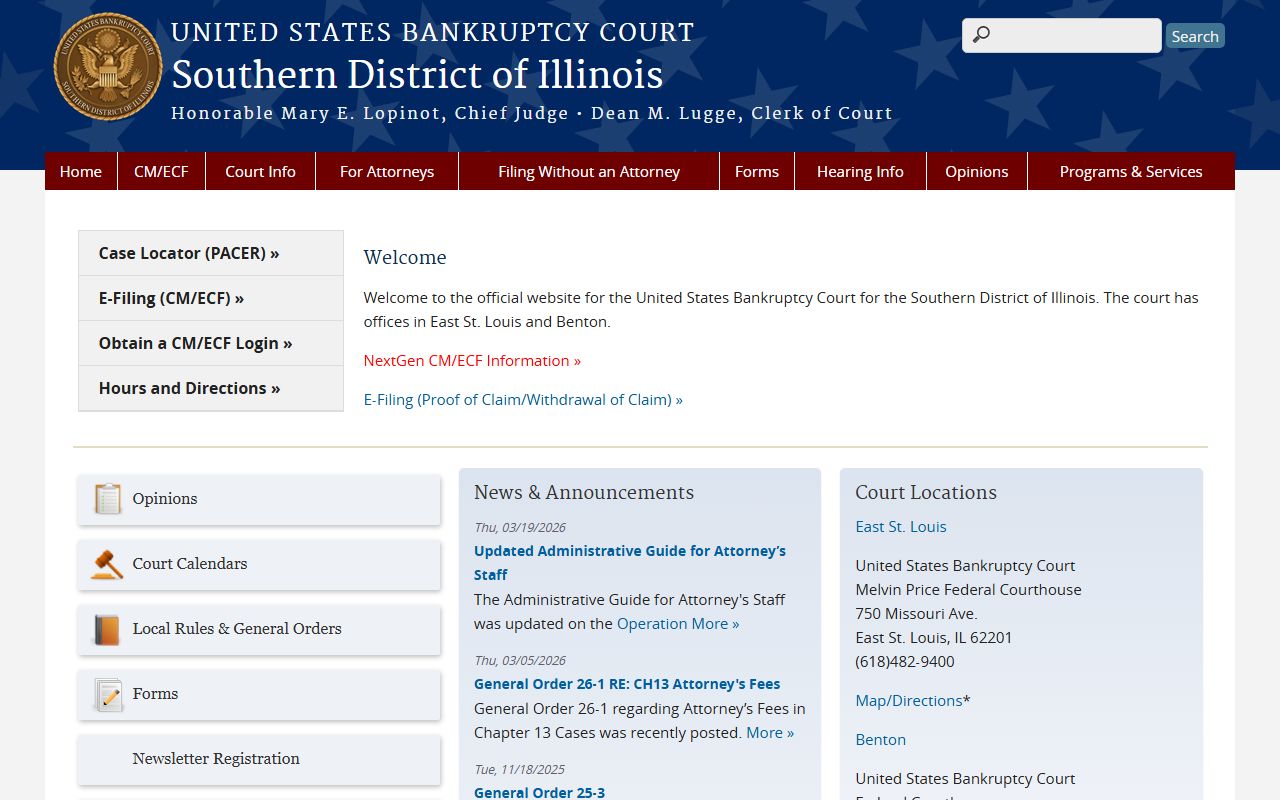 Bankruptcy is its own federal track and is not part of the Circuit Court case load in St. Clair County.
Federal appeals run through the Seventh Circuit. The U.S. Court of Appeals for the Seventh Circuit reviews District Court decisions from the Southern District of Illinois.  The Seventh Circuit page is the source for federal appellate procedure and opinions tied to local federal cases.
To search any federal case, the public uses PACER. The PACER federal case-access portal is the federal electronic public-access system. 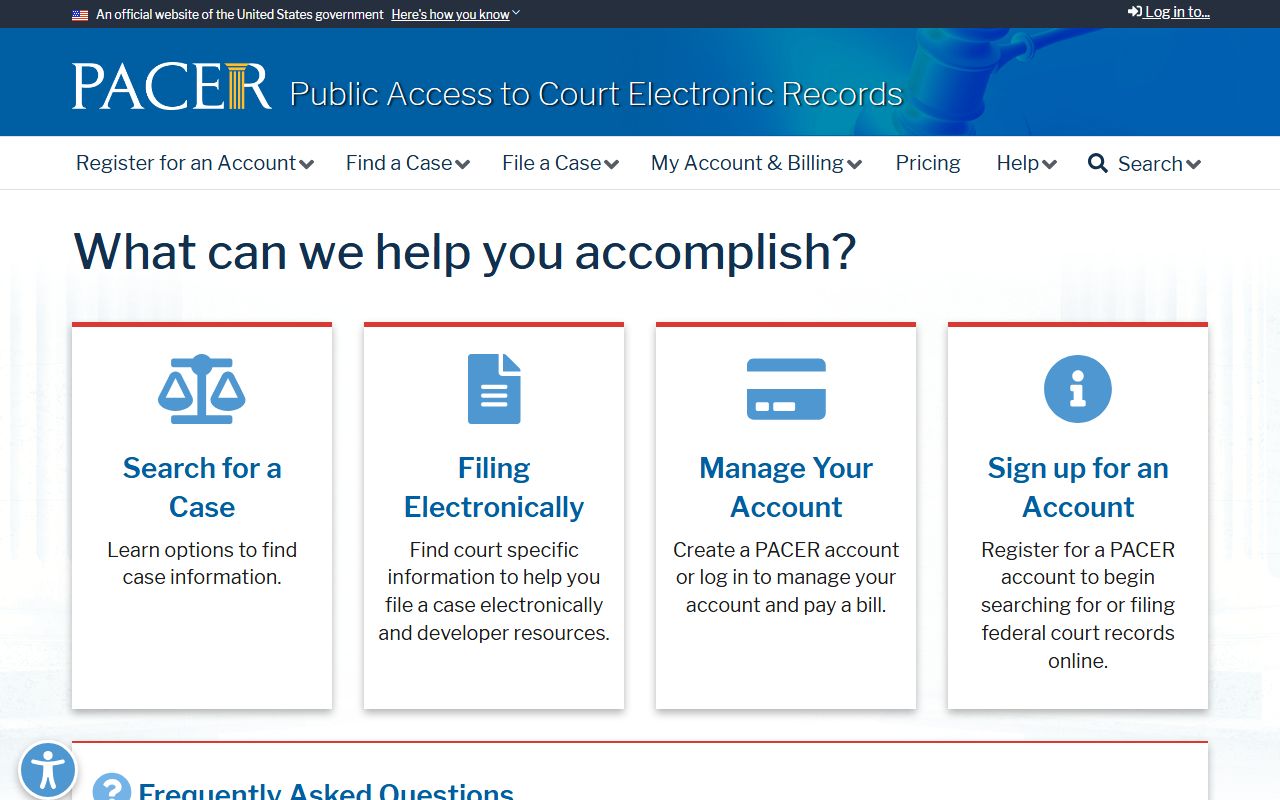 PACER requires registration and charges per-page fees, though some users qualify for fee exemptions. The Circuit Clerk does not host any federal case file.
Historical Context
St. Clair County was the first county established in Illinois. The Illinois State Archives notes that the county was set up while the area was still part of the Northwest Territory. Early county judicial sessions were held at Cahokia, Kaskaskia, and Prairie du Rocher long before Illinois became a state. That history is one reason the County Clerk holds certified marriage records that go back to 1763.
The modern Circuit Court system is more recent. Illinois moved to a unified Circuit Court structure in the 1960s, replacing a patchwork of trial courts that used to vary across the state. Since then, the Circuit Court has been the single trial court for state law cases in St. Clair County. The Circuit Clerk has been an elected office throughout, with each clerk serving a four-year term and keeping the official case record.
Old paper and microfilm files from the early Circuit Court still exist. Some live with the Illinois State Archives Regional Archives Depository program. A researcher looking for very old St. Clair County court records may need to go past the modern online portal and contact the Circuit Clerk or the archives directly. New cases, in contrast, are nearly all eFiled and live in the county case-management system.