
Active Warrants in St. Clair County
Warrants in St. Clair County are issued by a Circuit Court judge for the 20th Judicial Circuit. A judge signs the warrant after finding probable cause, after a person misses a court date, or after a probation officer files a violation petition. The Sheriff's Department in Belleville is the office that serves county warrants on the street. The State's Attorney often requests an arrest warrant when criminal charges are filed by information or indictment. Search warrants for police investigations are also signed by a Circuit Court judge and are often filed under the MX miscellaneous criminal case code.
No single public list of active St. Clair County warrants is published by the county on its website. The Sheriff's Department page in Belleville links Monthly Crime Calls, Crime resources, the Sex Offender search, the inmate lookup, and other tools, but it does not host an open active-warrant page. The Circuit Clerk runs a court-record search and a daily docket search that can show a case set for a warrant hearing, a failure-to-appear setting, or a probation violation. Those tools confirm that a case is active. They are not a direct active-warrant status page. The honest answer for an outstanding St. Clair County warrant is to verify with the Circuit Clerk for the case file and the Sheriff's Department for the custody side.
Court records can lag behind real-world events. The Circuit Clerk notes that cases are continued and reset all the time, and the inmate roster is updated hourly rather than in real time. A search done in the morning may look different by late afternoon. Always treat an online check as a starting point, then call the office that holds the underlying record.
Types of St. Clair County Warrants
Several kinds of warrants can show up in a St. Clair County case file. The label matters because the next step is different for each one. A bench warrant for a missed traffic date is not the same thing as a felony arrest warrant or a probation violation warrant. A search warrant is a third category that does not name a defendant as a suspect at all. Federal warrants from the Southern District of Illinois are tracked through their own system and never appear in the county case file.
- Arrest warrant. Issued by a judge based on probable cause that a person committed a crime, often after the State's Attorney files an information or a grand jury returns an indictment.
- Bench warrant. Signed from the bench by a judge after a missed court date, a missed payment, or contempt of a prior court order.
- Search warrant. Court order that lets police search a place or seize property; in St. Clair County these are often filed in the MX miscellaneous criminal case category and may be sealed before they are executed.
- Failure-to-appear warrant. Triggered by missing a setting in a criminal, traffic, DUI, or other case; typically issued as a bench warrant.
- Probation violation warrant. Filed when a probation officer reports that a person on probation did not follow the conditions of the sentence.
- Civil body attachment. A type of contempt warrant used in some civil and family enforcement matters, including missed child-support hearings.
- Federal warrant. Issued by a federal judge or magistrate; not part of the county warrant system, handled through the U.S. Marshals Service and the U.S. Attorney's Office.
A single case can carry more than one warrant over its life. A felony case can start with an arrest warrant and later add a bench warrant if the defendant misses a date after bond. Probation cases can stack arrest warrants and violation warrants on the same underlying criminal file.
How to Search for a St. Clair County Warrant
A St. Clair County warrant search starts with the official Circuit Clerk site, not a third-party site. The Circuit Clerk court record search is the main case-file tool. The Court Docket Search shows the daily docket and the attorney docket. Together they can flag a failure-to-appear setting or a warrant hearing date. The Sheriff's Department in Belleville is the right call for custody confirmation. The State's Attorney can confirm whether criminal charges have been filed in a case. For a free legal research view of related federal and state appellate matters, CourtListener has a public docket archive.
The best path is to chain the public tools and the phone in the right order. The court file is the anchor record. The custody side and the prosecution side both work off that same case number. The numbered list below walks through the practical steps a person can use to confirm whether a St. Clair County warrant is active and what to do next.
- Open the Circuit Clerk court record search from the official Circuit Clerk page. Use the case number if known, or run a party name search.
- Check the daily docket on the Court Docket Search page for a current setting. A warrant hearing or a failure-to-appear notation can show up under the case name.
- Call the Circuit Clerk at (618) 277-6600 to ask how the case is currently set. The clerk can tell you the next court date and whether the file shows an active warrant entry.
- Call the Sheriff's Department non-emergency line at (618) 277-3505 to ask whether a warrant has been entered for service. The jail at (618) 456-7606 can confirm current custody.
- If the warrant ties to a missed court date, ask whether a motion to recall or quash the warrant must be filed before turning yourself in.
- If the case is a felony, a domestic violence matter, a probation violation, or has an out-of-county or federal hold, talk to a lawyer before any voluntary appearance.
- For a federal matter, use the U.S. Attorney's Office for the Southern District of Illinois and the federal court system. County tools will not show a federal warrant.
- After resolution, recheck the court docket and the inmate lookup. Online updates can lag, and the case docket may not refresh on the same day as the court ruling.
St. Clair County Warrant Database Inspection
There is no St. Clair County active warrant search portal with its own fields. What exists are nearby tools the public can use to confirm parts of a warrant question. The table below mirrors what the research file documents about the public-facing tools that touch warrant questions, what each field looks like, and how each tool maps to a warrant search.
| Tool / Field | Type | Required | Notes / Format |
|---|---|---|---|
| Active warrant search | n/a | n/a | Not located in official St. Clair County sources; no public active-warrant list is posted by the county. |
| Court Record Search (party name) | Text | Optional | Circuit Clerk court-record portal; case-name search may surface a case with a warrant entry. |
| Court Record Search (case number) | Text | Optional | Year, type, and number components per the Circuit Clerk copy request form. |
| Court Docket Search (Begin Date) | Date | Optional | Loads the daily court docket for the chosen date. |
| Court Docket Search (Bar Number) | Text | Required for attorney docket | Attorney docket filter on the Circuit Clerk docket page. |
| Sheriff Inmate Lookup (Last Name) | Text | Optional | Confirms current custody; does not list all active warrants. |
| Sheriff Inmate Lookup (Booking Number) | Text | Optional | Fastest single-input lookup once a person has been booked. |
None of these tools is a true active-warrant index. Each one solves a different part of the question. The court record search shows whether a case exists. The docket shows whether the case is set. The inmate lookup shows whether a person is in custody right now. A real warrant confirmation usually takes a phone call to the Circuit Clerk or the Sheriff's Department on top of the public tools.
What a St. Clair County Warrant Record Shows
When a warrant is part of a St. Clair County court file, the Circuit Clerk's case record can carry a set of related fields. The list below is built from the case-record fields the Circuit Clerk documents and the standard parts of a warrant order. A formal warrant document, when filed in the public part of the case, will normally show identifying data, the underlying charge, and the issuing judge.
| Field | What It Shows |
|---|---|
| Case Number | Year, type code, and number used by the Circuit Clerk; the warrant ties to this case. |
| Case Type | Category code such as CF for felony, CM for misdemeanor, DT for DUI, TR for minor traffic, or MX for miscellaneous criminal. |
| Party Name | Defendant or respondent named in the case; the warrant lists this person as the subject. |
| Warrant Type | Arrest, bench, search, failure-to-appear, or probation violation as set out in the court order. |
| Issue Date | Date the judge signed the warrant. |
| Issuing Judge | Circuit Court judge of the 20th Judicial Circuit who signed the order. |
| Underlying Charge | Statute or offense behind the arrest warrant; not present on a search warrant return until it is unsealed. |
| Bond Amount | Cash or D-bond amount set by the court, if any, for release after arrest. |
| Status | Active, recalled, quashed, served, or returned per docket entries. |
Some of these fields can be sealed or restricted under court rules. A search warrant filed under the MX category may be sealed until it is executed. A juvenile warrant under JA or JD case codes is treated as confidential under the Juvenile Court Act. A warrant tied to an order of protection can have redacted address fields when the protected party's location is at risk.
The Circuit Clerk does not publish a stand-alone sample warrant inspection in the harvested county pages. The fields above reflect the documented case-record structure and the standard contents of an Illinois warrant order, and any specific field should be confirmed against the actual court file before it is relied on.
What to Do If You Have an Outstanding Warrant
An outstanding warrant in St. Clair County does not always mean a person will be picked up that day. It does mean any traffic stop, license check, or police contact can turn into an arrest. The right move depends on the type of warrant, the charge, and whether bond has been set. A felony warrant, a domestic violence warrant, and a probation violation warrant should never be walked into without legal advice. A traffic bench warrant for a missed court date is usually a far simpler fix.
- Confirm the warrant first. Use the Circuit Clerk court record search, then call the clerk and the Sheriff's Department before doing anything else.
- If the warrant is for a missed court date, ask the Circuit Clerk how the case is set. The court can sometimes recall or quash a warrant on motion before any arrest.
- If bond is set, confirm the bond type, the amount, and how the jail accepts payment. Bring the right form of payment and a photo ID.
- If the charge is a felony, a probation violation, a domestic battery, or anything carrying a real risk of custody, hire a lawyer or ask the court for a public defender before any voluntary appearance.
- Plan the timing. A weekday morning surrender is easier to process than a Friday night walk-in. The jail at 700 N. 5th Street in Belleville handles intake.
- Bring identification, the case number, and any paperwork from the court that ties to the warrant. Leave valuables and electronics at home.
- After the case is set in court, recheck the docket. The online docket and the inmate roster may not refresh on the same day as the hearing.
Important: Talk to a lawyer before you turn yourself in on a felony, domestic violence, or probation violation warrant; voluntary surrender without counsel can change the bond outcome.
Bench Warrants and Failure-to-Appear
Bench warrants are the most common warrant a routine court user runs into. A judge signs a bench warrant from the bench when a defendant fails to appear for a setting, fails to pay a fine, or violates a court order. In St. Clair County, missed traffic and misdemeanor settings are the typical source. The Court Docket Search will show the missed date as a setting, and the case status can shift to a warrant entry on the next docket cycle.
Failure-to-appear in a DUI case under the DT code, a domestic battery case under the DV code, or a felony under the CF code carries more weight than a minor traffic FTA. Bond conditions, license suspensions, and probation status can all change after a missed date. The Illinois Secretary of State can also act on a license when the underlying case is traffic-related, even though that is a separate executive-branch record from the court file.
The fix for a bench warrant is normally a motion to recall or quash the warrant, filed through the Circuit Clerk, along with a new court setting. Some judges will set the motion the same week. Others require a personal appearance. The Circuit Clerk's main number is the right first call when a bench warrant shows up on a case.
Search Warrants and Sealed Court Records
Search warrants in St. Clair County are signed by a Circuit Court judge after police submit an affidavit showing probable cause. The Circuit Clerk case categories list MX miscellaneous criminal as the bucket that holds search warrants, grand jury proceedings, eavesdropping orders, seized property cases, sealing and expungement petitions where no separate criminal case exists, habeas corpus, and administrative subpoenas. That means a public records check for an MX case is the closest the county comes to a search-warrant database.
Sealing is common. A search warrant can be sealed before it is executed so the target does not learn about it in advance. After execution, the warrant, the affidavit, and the inventory may be unsealed by court order. Some warrants stay sealed for the life of the case, especially when grand jury matters or active investigations are involved. The Criminal Identification Act sealing rules at 20 ILCS 2630/5.2 govern broader sealing and expungement, while routine investigative sealing is handled under court rules and case-by-case orders.
A person who thinks property was seized in a St. Clair County search should contact the State's Attorney's Office. The State's Attorney handles forfeiture filings and the underlying criminal case. The Circuit Clerk can confirm whether an MX case has been opened tied to that seizure.
Federal Warrants and the Southern District of Illinois
Federal warrants are not part of the St. Clair County system. A federal arrest warrant, a federal search warrant, or a federal grand jury indictment in a case tied to Belleville will move through the U.S. District Court for the Southern District of Illinois, the U.S. Attorney's Office for the Southern District of Illinois, and the U.S. Marshals Service. The county Sheriff has no role in serving a federal warrant, although local agencies often work joint task force cases with federal partners.
The U.S. Attorney's Office page is the main public-facing landing site for federal prosecutions in this district. The U.S. Attorney's Office for the Southern District of Illinois page covers leadership, divisions, press releases, and contact information for the federal prosecutors who handle cases out of Fairview Heights, Benton, and East St. Louis. 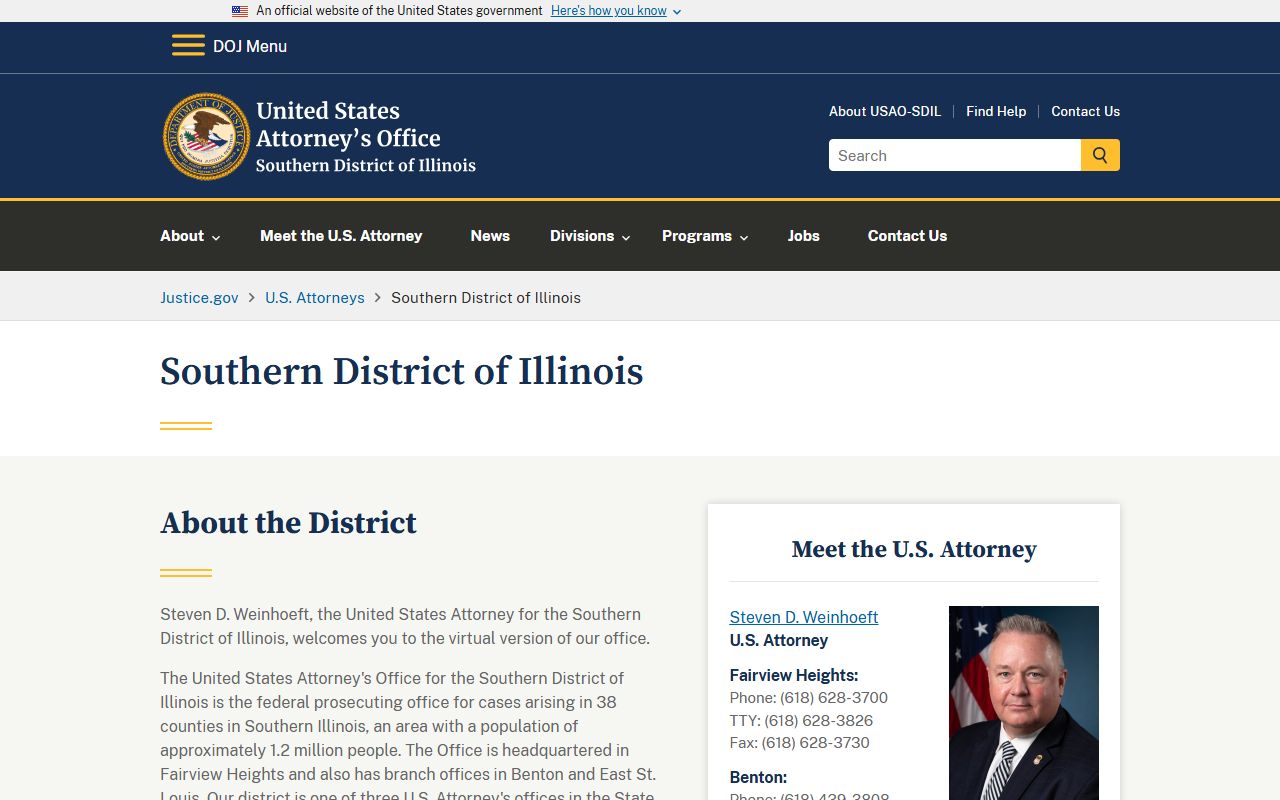 The USAO page is the right starting point when a federal prosecutor, federal grand jury matter, or federal warrant ties to a St. Clair County case.
The U.S. Marshals Service Southern District of Illinois page is the operations side of federal warrant service in the district. Public access to that page was not reliable in the research pass, and the Marshals do not publish a standing open warrant list for the district. The same is true for the federal court itself. Federal court records flow through PACER, not through any St. Clair County portal.
CourtListener as a Free Legal Research Tool
For warrant questions that have already made it to a court order or an appeal, the Free Law Project runs CourtListener as a free legal research database. CourtListener does not host active St. Clair County warrants, and it is not a substitute for the Circuit Clerk court record. It does host federal court dockets, appellate opinions, and many state-level documents that can help a researcher trace a case back to the underlying warrant facts.
The CourtListener site indexes opinions from the U.S. Supreme Court, the federal courts of appeals, and many state appellate courts. It also archives PACER dockets through the RECAP project. 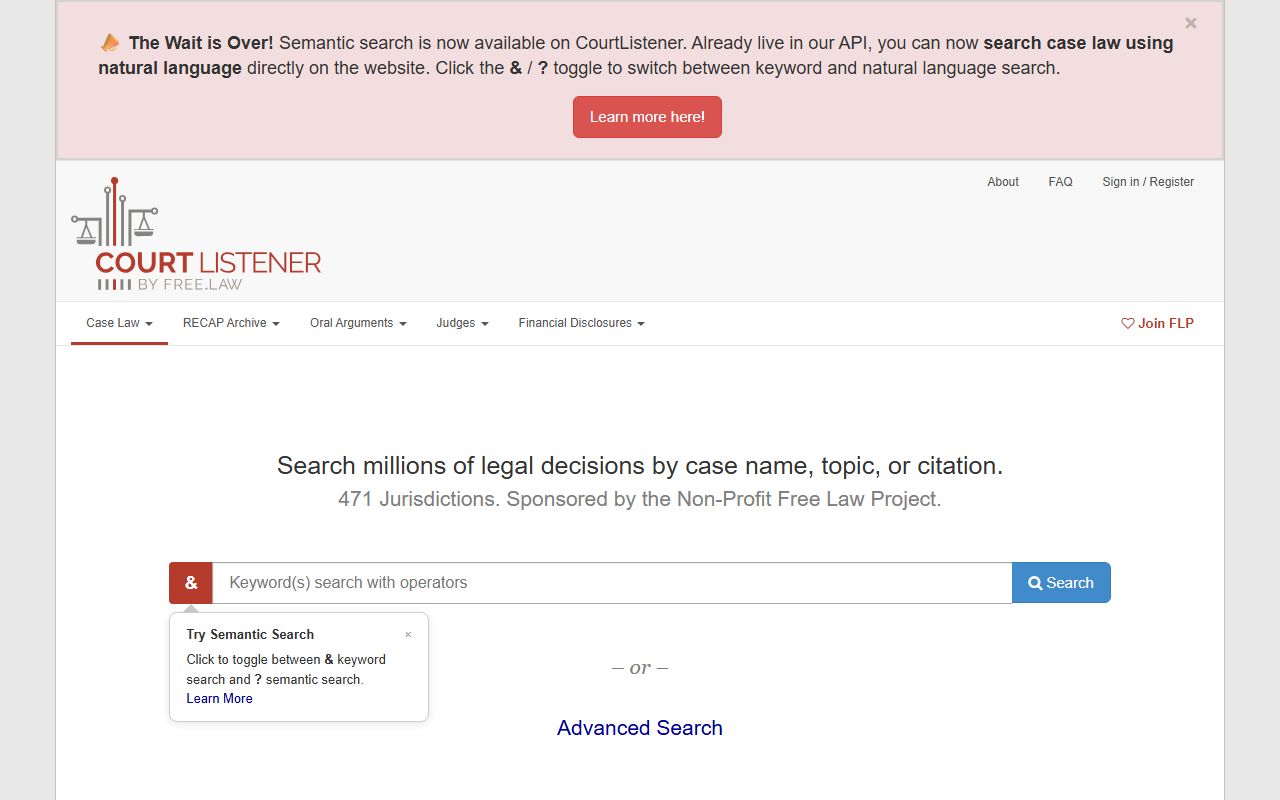 CourtListener is the source above for free federal docket access and appellate opinions tied to St. Clair County matters.
A reasonable workflow is to use the Circuit Clerk for the county case file, the Sheriff for custody, the U.S. Attorney for federal questions, and CourtListener for background research on similar federal warrant cases or appellate rulings out of the Fifth District. Each tool covers a different layer of the same legal record.
Restricted St. Clair County Warrant Records
Some warrant records are not public. Juvenile warrants under the Juvenile Court Act are confidential and do not appear on a general public docket. Search warrants under the MX code can be sealed before they are executed. Adoption-related warrants and certain mental-health holds carry strong privacy protections under state law. Even on a public adult criminal case, fields like home addresses, victim information, and child information can be redacted.
Sealing and expungement orders also remove records from public view. A case that has been sealed by court order under the Criminal Identification Act will not show up in the public Circuit Clerk search the same way an open case does. The underlying warrant entry is part of that sealed file. A person who has obtained a sealing or expungement order should expect that the public-facing record will be cleaned up, but third-party aggregator sites are outside any court order and may keep older entries.