
How to Search St. Clair County Criminal Records
The Circuit Clerk's Court Record Search is the main public source for St. Clair County criminal records. The portal is linked from the Circuit Clerk page and covers civil and criminal court dates. For an arrest that has not been charged yet, the Sheriff's Inmate Lookup is the right place to check current custody. A booking entry does not always mean charges have been filed, so the inmate lookup and the Court Record Search are often used together.
Search inputs differ by tool. The court search uses a name or a case number split into year, type, and sequence. The Sheriff's roster uses last name, first name, or booking number. The IDOC search uses a name or IDOC number for people sentenced to state prison.
- Open the Circuit Clerk Court Record Search and look up the name or case number.
- Use the case category code to narrow results - CF, CM, DT, or DV for criminal cases.
- Open the case to view charges, court dates, and any disposition that has been entered.
- For current custody, run the Sheriff's inmate lookup by name or booking number.
- For Illinois prison custody, run the IDOC search with name or IDOC number.
St. Clair County Criminal Case Categories
Criminal cases in St. Clair County use two-letter Illinois case codes set by Supreme Court rule and listed on the Circuit Clerk's Case Categories page. Knowing the right code can save hours of name-based searching.
- CF - Criminal Felony. Any complaint, information, or indictment with at least one felony count under the Unified Code of Corrections.
- CM - Criminal Misdemeanor. The most serious charge carries under one year of imprisonment and falls into Class A, B, or C.
- DT - DUI. Driving under the influence under 625 ILCS 5/11-501 and related snowmobile and boat statutes.
- DV - Domestic Battery. Domestic battery and related domestic-violence case category.
- MX - Miscellaneous Criminal. Search warrants, grand jury, statutory summary suspensions, eavesdropping, seized property, sealing and expungement petitions, habeas corpus, and administrative subpoenas.
- CC - Contempt. Direct contempt against a non-party or juror.
- QC - Quasi-Criminal. Petty and business offenses outside Class A, B, or C.
The State's Attorney and Criminal Prosecution
Criminal cases in St. Clair County are prosecuted by the St. Clair County State's Attorney. The current State's Attorney is James Gomric. The office is at 10 Public Square in Belleville with a main phone of (618) 277-3892. 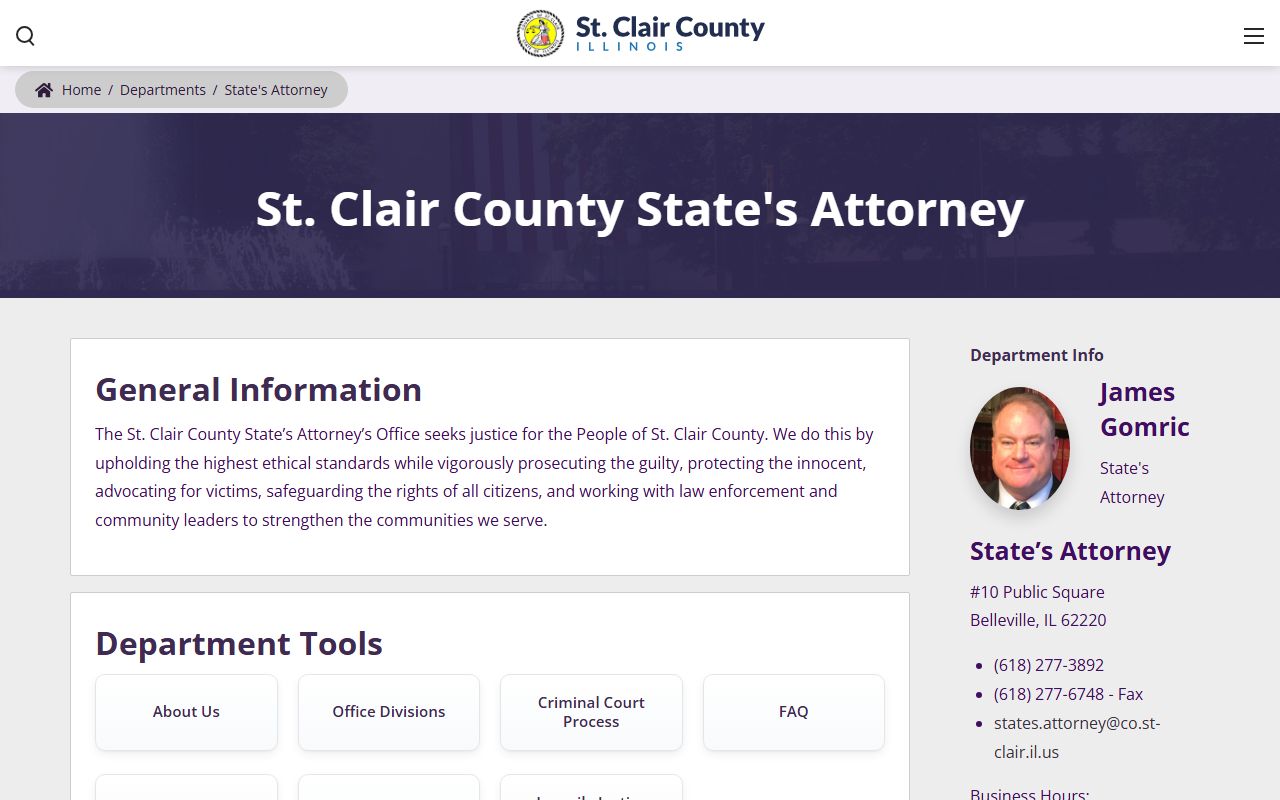 The State's Attorney landing page links the office's divisions, victim services, and Criminal Court Process FAQ.
The State's Attorney's office has criminal, children's justice, and governmental affairs divisions. The About Us page says the office employs 28 full-time Assistant State's Attorneys and 22 support staff members. 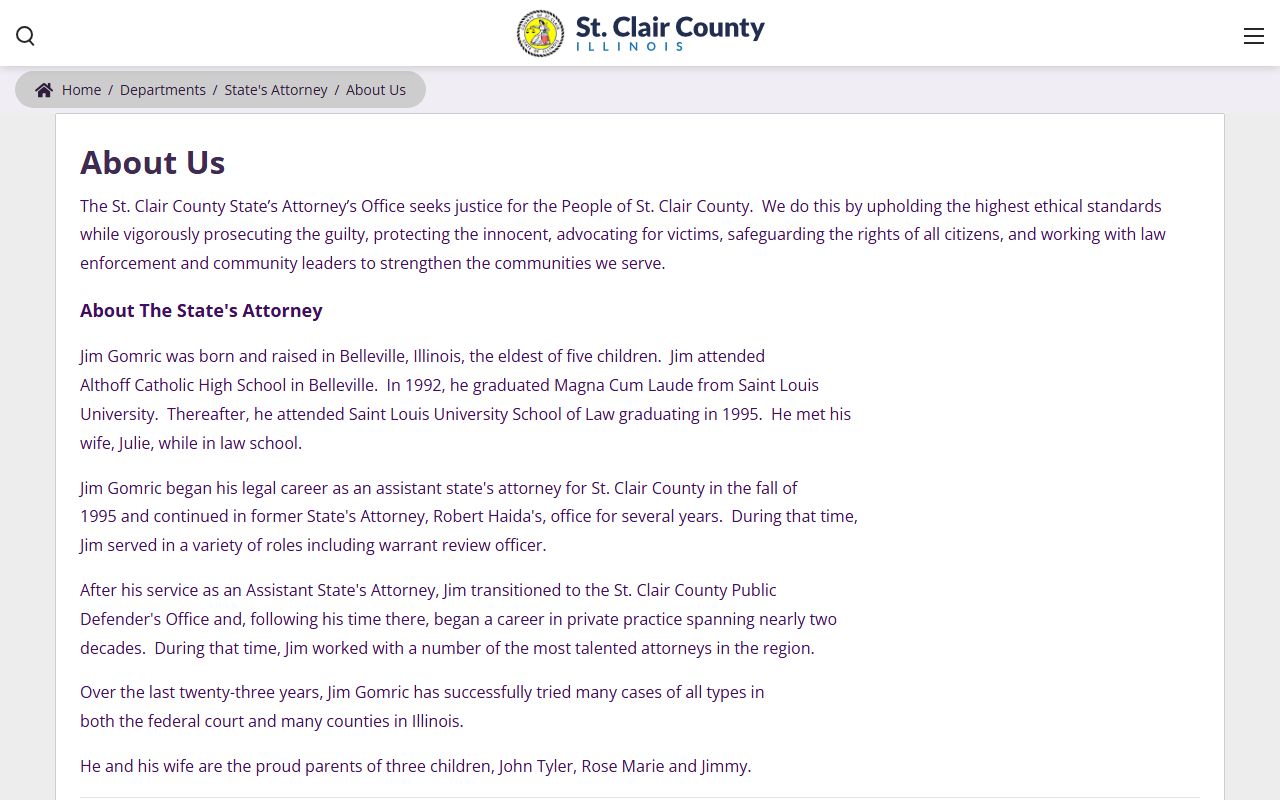 The About page gives the staffing and leadership context for criminal prosecution in St. Clair County.
The office's leadership includes First Assistant Daniel E. Lewis, Chief of the Criminal Bureau Jason Emmanuel, Chief of the Children's Justice Division Bernadette Schrempp, Chief of the Governmental Affairs Division Chris Allen, and Chief Investigator Phil Delaney. The Public Defender appears in the county budget but does not publish a separate public page; indigent defense is appointed by the court when a defendant qualifies.
Arrest Record vs Court Record
An arrest record and a court record are not the same. The Sheriff or local police create an arrest record when a person is taken into custody. The Circuit Court file does not exist until charges are filed by the State's Attorney. A booking can show up on the Sheriff's inmate lookup hours or days before a case number appears in the Circuit Clerk's search.
The table below sets the two records side by side so a researcher knows which office holds what.
| Record | Custodian | What It Shows |
|---|---|---|
| Arrest record | Sheriff or arresting police agency | Booking date, booking number, charges at intake, custody status. |
| Court file | Circuit Clerk | Case number, formal charges, court dates, motions, disposition. |
| Illinois criminal history | Illinois State Police | Statewide rap sheet from fingerprint records; access is restricted. |
| IDOC custody | Illinois Department of Corrections | State prison custody for people sentenced to a term of imprisonment. |
Charges vs Convictions
A charge is not a conviction. The two often get mixed up when reading St. Clair County criminal records. A charge is what the State's Attorney files at the start of the case. A conviction is what the court enters at the end after a plea or a trial. A case may be dismissed, reduced, set for supervision, or end in a not guilty verdict. The disposition field in the court file is the place to read what actually happened.
| Charges | Convictions |
|---|---|
| Filed by the State's Attorney at the start of a case. | Entered by the court at the end after a plea or trial. |
| Listed in the complaint, information, or indictment. | Listed in the disposition and sentence fields. |
| Can be dismissed, reduced, or set for supervision. | Final adjudication of guilt by plea or verdict. |
| Open to public search through the court record. | Open to public search unless sealed or expunged. |
State Prison and Illinois Department of Corrections
People sentenced to state prison in a St. Clair County criminal case are held by the Illinois Department of Corrections. The IDOC Individual in Custody Search is the public lookup tool. 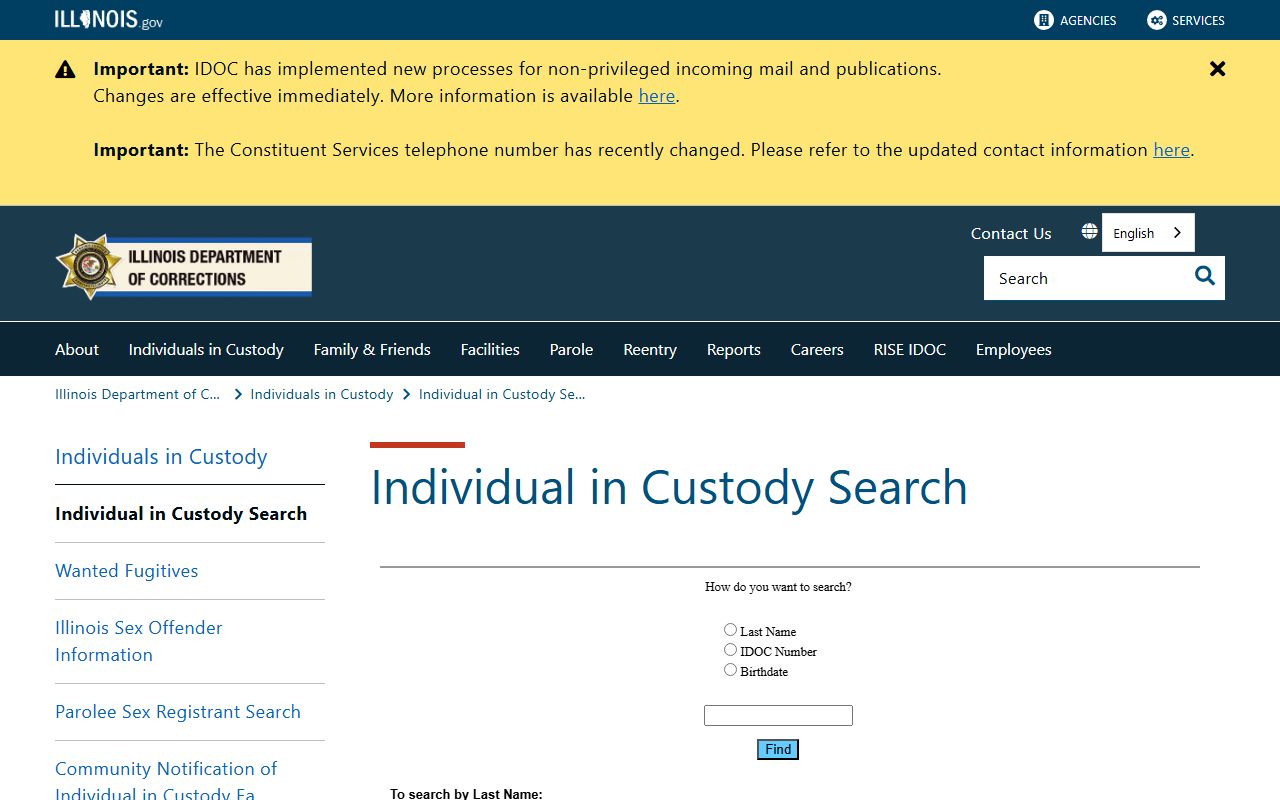 The IDOC search returns the state-level custody record for a sentenced person.
An older legacy search is also live. The legacy IDOC search page shows the same general access notice and may be useful when the newer page is down for maintenance. 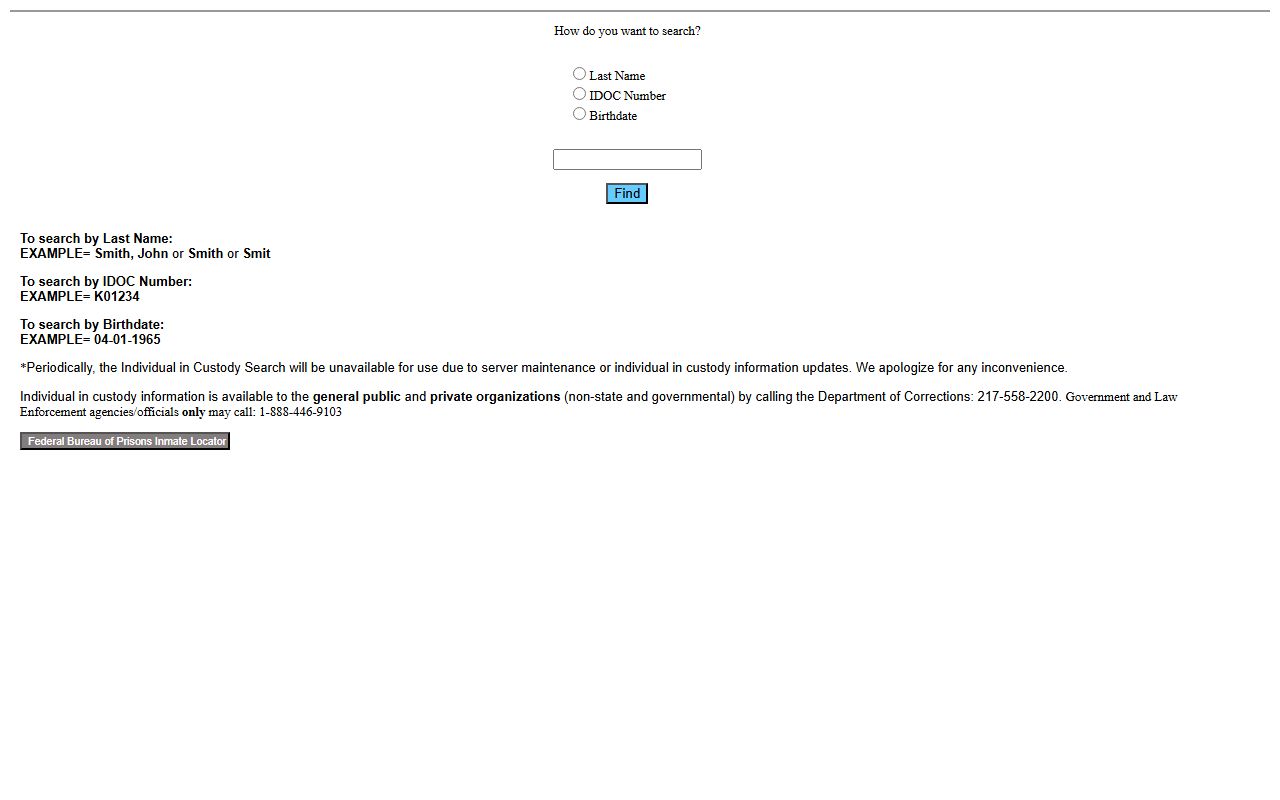 The legacy page says individual-in-custody information is available to the general public and that some search functions may be unavailable for updates.
The Sheriff's jail and the IDOC are two different systems. A person held in St. Clair County pretrial is on the Sheriff's inmate lookup. A person who has been sentenced and transferred is on the IDOC search. The released inmates page covers post-release lookup tools.
Illinois Sex Offender Registry
The Illinois State Police runs the public Sex Offender Registry after a one-click disclaimer agreement. The registry covers people required to register under Illinois law. 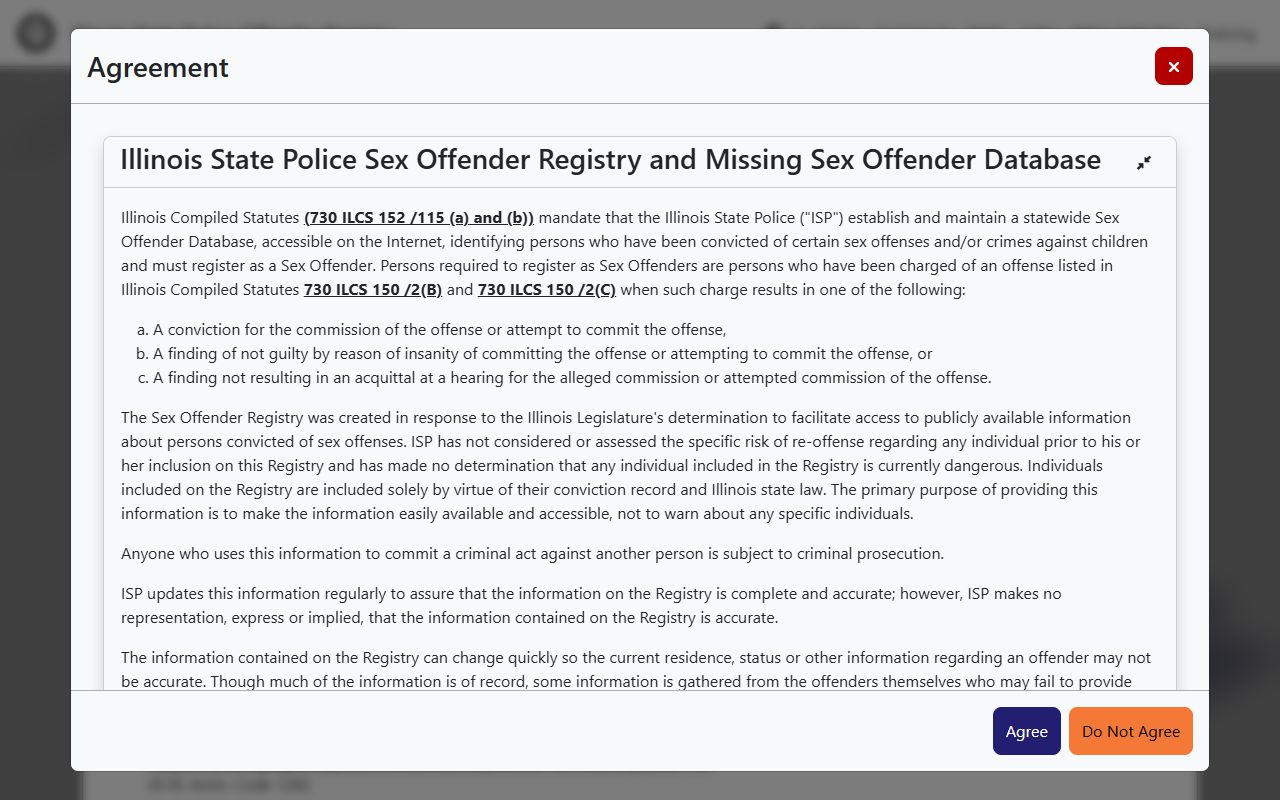 The registry supports searches by name and by city, county, or ZIP code, which is the route most St. Clair County users follow.
Not every person with a criminal record is a registrant. The registry is governed by separate statutes that set who must register and for how long. The Illinois State Police, not the local Sheriff or Circuit Clerk, is the agency that updates the registry record.
Sealing and Expungement
Illinois has a sealing and expungement statute at 20 ILCS 2630/5.2. The statute sets the rules for adult criminal record relief. 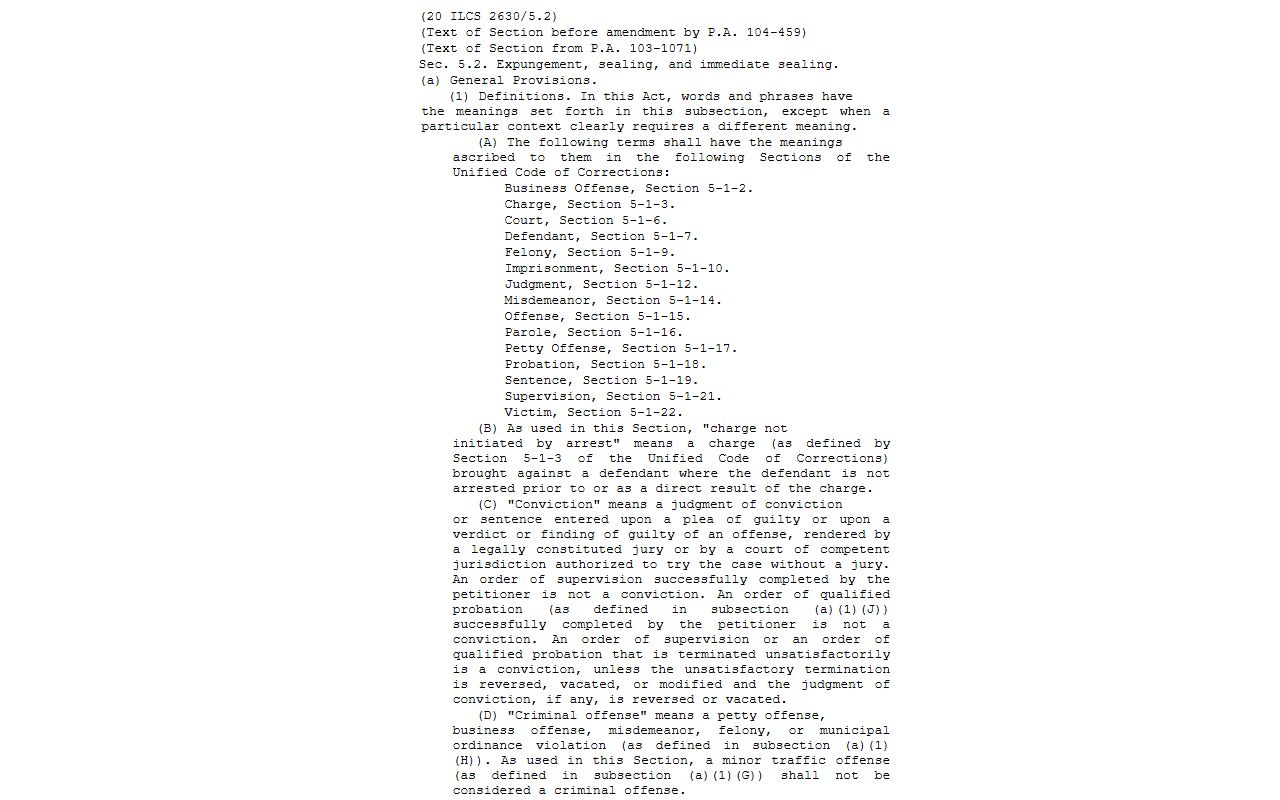 The statute page is the source for the petition rules described below.
| Sealed | Expunged |
|---|---|
| Record is maintained but restricted from public access. | Record is removed, destroyed, or returned as authorized by statute. |
| Available to law enforcement and statutory users. | Treated as if the case did not happen, with narrow exceptions. |
| Available for some convictions after a waiting period. | Generally for arrests with no conviction and certain dispositions. |
| Petition filed in the Circuit Court where the case was heard. | Petition filed in the same Circuit Court. |
A petition must include the petitioner's name, date of birth, current address, case number, arrest date, and arresting authority. Fees apply unless the court grants a waiver under Supreme Court Rule 298. The State's Attorney, Illinois State Police, and the arresting agency get notice and a chance to object. DUI, reckless driving, some sex offenses, and a number of other dispositions have statutory limits or exclusions, so a person looking at relief should check the statute against their specific case.
Warrants, Missed Court Dates, and Background Checks
A missed court date can lead to a bench warrant or a failure-to-appear warrant. The case docket may show a warrant request or a continued setting for the warrant. Active warrant questions are covered in detail on the warrant records page. The Circuit Clerk and the Sheriff's Office are the right offices to call before walking in on an active warrant.
For background checks, an arrest record on a court file is public unless sealed or expunged. An Illinois criminal history file from the State Police is separate and access is restricted under the Uniform Conviction Information Act and related rules. Employers using a third-party background check are governed by the federal Fair Credit Reporting Act. The legal notice in the footer of this site explains why this site cannot be used for FCRA-regulated purposes.
Legal Aid and Public Defender
Indigent defense in St. Clair County is appointed by the court at the first appearance. The Public Defender is a county-funded office that handles eligible criminal cases. The 2025 county budget shows a Public Defender appropriation of $1,080,608. For people who do not qualify for the Public Defender or who want self-help options, Illinois Legal Aid Online and Land of Lincoln Legal Aid run statewide and regional resources for criminal-record relief, expungement clinics, and related needs.
Note: A first-appearance judge decides whether a defendant qualifies for the Public Defender; bring proof of income to court if requesting appointed counsel.