
How to Search St. Clair County Traffic Court Records
The Circuit Clerk's Court Record Search is the public source for St. Clair County traffic court cases. The Circuit Clerk page states the portal may be used to access all civil and criminal court dates, which includes traffic dates. Court cases get continued and reset, so the Circuit Clerk tells users to recheck the site rather than rely on a single visit.
Before starting, gather what is on the ticket. A citation number is the fastest path. A last name plus first name works as a fallback. Date of birth and the case type code can narrow a long results list when many drivers share a name. The Circuit Clerk's copy request page splits the case number into Year, Type, and Number, so a researcher who knows just one piece can still get close.
| Search Field | Type | Required | Notes / Format |
|---|---|---|---|
| Case number | Text | One of name or number | Year, Type code (TR, MT, DT, OV), and sequence number. |
| Last name | Text | If no case number | Use the name on the citation, not a nickname. |
| First name | Text | Recommended | Narrows shared-last-name results. |
| Citation / ticket number | Text | Optional | Printed on the ticket; fastest single-field lookup. |
| Court date | Date | Optional | Useful for daily docket cross-checks. |
- Open the Circuit Clerk Court Record Search from the Circuit Clerk page.
- Enter the citation number, or the last and first name from the ticket.
- Filter by the case type code (TR, MT, DT, or OV) if known.
- Open the case to view charges, court date, plea, and any disposition entered.
- Pay the fine, set a hearing date, or use the Circuit Clerk's copy request page for a certified copy.
Which Courts Handle Traffic Cases in St. Clair County
Every traffic case in St. Clair County is filed in the Circuit Court. Illinois Courts lists St. Clair as a single-county circuit, so there is no separate justice-of-the-peace court and no separate municipal traffic court to chase down. The 20th Judicial Circuit sits at the county courthouse at 10 Public Square in Belleville. Minor traffic tickets, major traffic charges, DUI, and many ordinance violation matters all run through that same court system.
Municipal ordinance violations work a bit differently. Some cities and villages in the county handle their own ordinance hearings at the city level. Others route ordinance citations to the county Circuit Court under the OV code. The Circuit Clerk's Case Categories page is the source for which codes the county uses.
| Court / Office | Traffic Cases Handled | Address |
|---|---|---|
| St. Clair County Circuit Court (20th Judicial Circuit) | TR, MT, DT, and county OV cases | 10 Public Square, Belleville, IL 62220 |
| Circuit Clerk's Office | Files citations, holds court records, takes ticket payments | #10 Public Square, Belleville, IL 62220 |
| Probation & Court Services | Court-ordered traffic supervision, DUI evaluations, drug testing | 11 W. Lincoln, Belleville, IL |
Types of Traffic Cases on Record
St. Clair County traffic court records use four main case-type codes set by Illinois Supreme Court Rule 501 and listed on the Circuit Clerk Case Categories page. Knowing the right code can save a lot of name-based searching when court files get pulled.
- TR (Minor Traffic). Traffic and local ordinance matters defined by Rule 501. Most speeding tickets, stop-sign tickets, and similar moving violations land here.
- MT (Major Traffic). Major traffic cases under Rule 501(f)(1)(i), except DUI, plus local ordinances handled under Rule 501. Reckless driving and leaving the scene are common MT charges.
- DT (DUI). Driving under the influence under 625 ILCS 5/11-501 and related snowmobile and boat statutes. DT overlaps with the criminal docket.
- OV (Ordinance Violation). County or municipal ordinance citations filed with the Circuit Clerk, including some local traffic-adjacent matters.
- QC (Quasi-Criminal). Petty and business offenses outside Class A, B, or C that sometimes appear next to traffic in a driver's file.
What St. Clair County Traffic Court Records Show
A traffic case file in St. Clair County looks a lot like any other criminal-side court record, but with extra fields tied to the ticket itself. The Circuit Clerk's copy request page splits the case number into Year, Type, and Number, and the Court Docket Search exposes name, date, appearance description, case or ticket / offense, prosecutor name, and courtroom. The fields below are what a researcher should expect to see on a typical traffic file.
| Field | What It Shows |
|---|---|
| Case Number | Year, Type code (TR, MT, DT, OV), and sequence number assigned by the Circuit Clerk. |
| Citation Number | Ticket number written by the officer at the stop. |
| Charges / Statute | Vehicle Code section or local ordinance cited on the ticket. |
| Court Date | Next scheduled appearance, set by the court or written on the ticket. |
| Plea | Guilty, not guilty, or no contest entered on the record. |
| Disposition | Outcome such as conviction, dismissed, supervision, or guilty plea. |
| Fines and Fees | Amount owed, paid, or set aside; the Circuit Clerk also tracks costs and bond. |
| Supervision Status | Whether court supervision was ordered and whether it was completed. |
| Prosecutor / Courtroom | Prosecutor name and courtroom from the daily docket. |
Searching by Citation Number vs by Name
Both search paths work in St. Clair County, but they fit different needs. The citation number maps to one ticket and one court file. A name search may pull every case ever filed against a person who shares a name with the driver on the ticket. For most quick lookups, the citation number wins.
Name searches make sense when the ticket has been lost or when a researcher is checking a person's full traffic history. The trade-off is more results to sort through, plus the risk of a false match. A middle name, date of birth, or case type code helps narrow the list.
- Citation number. Fastest path. One ticket, one match, no name guessing.
- Name. Broader path. Good for full driver history, but be ready to filter shared-name results.
- Year + Type + Number. Use when the case number is partly known; matches the copy request form fields.
- Court date. Useful for cross-checking against the daily docket when a case file is hard to find.
Paying or Contesting a St. Clair County Traffic Ticket
The Circuit Clerk runs ticket payment and court setting for St. Clair County traffic citations. In-person payments are taken at the first-floor criminal cashier booth at the county courthouse, Monday through Friday from 8:15 a.m. to 4:00 p.m. The office accepts cash, money order, business check, or credit card, with only one payment type allowed per transaction. The card usage fee is 2.25 percent with a minimum of $1.00. Mail-in payments go to P.O. Box 691, Belleville, IL 62222.
A driver who wants to contest the ticket has to set a court date instead of paying. That means appearing on the court date listed on the ticket, entering a plea, and asking the court for a hearing or a bench trial. Court supervision is often the goal for a first-time offender, since a successful supervision keeps the conviction off the record at the end.
- Read the ticket. Note the court date, the citation number, and the charge.
- Decide whether to pay the fine or contest the ticket; paying it usually counts as a guilty plea.
- To pay online, use the Circuit Clerk's payment page linked from the Circuit Clerk landing.
- To pay by mail, send a money order or business check to P.O. Box 691, Belleville, IL 62222.
- To pay in person, visit the criminal cashier booth at 10 Public Square in Belleville.
- To contest, appear on the court date, enter a not guilty plea, and ask for a hearing or bench trial.
- If the case ends in supervision, comply with all conditions until the file is closed by the court.
Note: Missing a court date can lead to a failure-to-appear warrant, so set a calendar reminder for the date printed on the citation.
Public Access Laws for Traffic Court Records
Illinois public-records access splits into two tracks. Administrative records of a public body are governed by the Illinois Freedom of Information Act. Court files held by the Circuit Clerk are governed by court rules, common-law access, and the Illinois Supreme Court's electronic access policy. A traffic case file is a court record, so the Circuit Clerk's process is the right path, not a generic FOIA letter.
The base FOIA framework sits in the Illinois Compiled Statutes at 5 ILCS 140. A copy of the Illinois Compiled Statutes page for a related Act gives a sense of how ILGA renders the underlying chapters that hold the traffic statutes and the rules of access. The same statute database holds 625 ILCS 5 for the Vehicle Code and 705 ILCS for court records.
An ILGA statute page shows the format used to render Illinois Compiled Statutes chapters online. 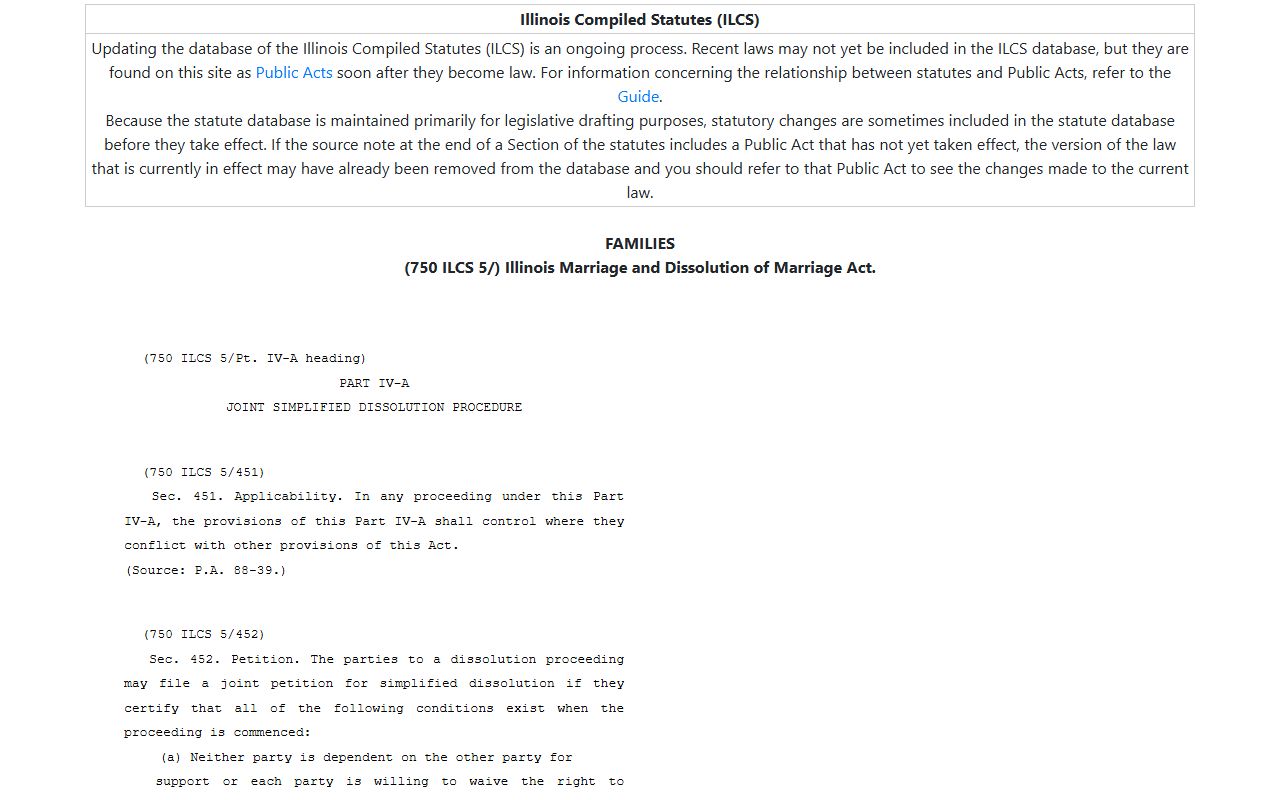 ILGA hosts the same Compiled Statutes view for vehicle, criminal, and procedure chapters that govern St. Clair County traffic court records.
Key Statutes:
5 ILCS 140 - Illinois Freedom of Information Act. Sets the public-body access framework that backs the County Clerk and Sheriff record-request process.
625 ILCS 5/11-501 - Illinois Vehicle Code DUI section. The base statute behind every DT case filed in the county.
Illinois Supreme Court Rule 501 - Defines minor traffic and major traffic, which sets which TR or MT code a ticket gets.
Court Traffic Records vs State Driver Records
The court traffic record and the state driver record are two different files. The court file lives with the Circuit Clerk in Belleville. It shows the case, the charge, the plea, and the disposition. The state driving abstract lives with the Illinois Secretary of State. It shows the driver's license status, conviction history, and points. The same ticket creates both records, but they are pulled from different offices and used for different things.
Drivers who want the official driving abstract can order it from the Illinois Secretary of State. The Secretary of State's driving record abstract page explains the purchase process. The same office publishes form DSD DC164 for mail-in abstract requests. Neither document is held by the Circuit Clerk and neither can be ordered through the county.
| Record | Source | What It Shows | How to Access |
|---|---|---|---|
| Court Traffic Record | St. Clair County Circuit Clerk | Case number, charges, court date, plea, disposition, fines, supervision status. | Circuit Clerk Court Record Search or in-person copy request. |
| State Driver Record (Abstract) | Illinois Secretary of State | License status, conviction history, points, suspensions, revocations. | Order through ilsos.gov or mail form DSD DC164. |
| Error Correction | Originating office | Disputed entries are fixed by the office that holds the record. | Court errors: motion in the Circuit Court. License errors: SoS dispute process. |
CDL and Commercial Driver Records
A commercial driver license carries stricter rules than a regular Illinois license. Federal Motor Carrier Safety Administration rules require states to track CDL convictions and report them to a national database. That means a traffic ticket against a CDL holder can affect the commercial driving record even if it was issued while the driver was off duty in a personal vehicle.
Illinois does not allow CDL holders to accept court supervision for traffic offenses committed in a commercial vehicle, and even some personal-vehicle convictions cannot be hidden. A CDL holder who gets a St. Clair County traffic ticket should usually appear in court rather than mail in a fine, since the consequences for the license are different from those for a regular driver. The Circuit Clerk records the conviction either way; the Secretary of State reports it to the federal system.
DUI / DWI Cases
Driving under the influence is filed under the DT case type code in St. Clair County, but the file overlaps with the criminal docket. DT cases are prosecuted by the State's Attorney, can carry jail time, and run through the same arraignment-to-disposition flow as a misdemeanor or felony case. A first DUI is usually a Class A misdemeanor; repeat or aggravated DUI can be a felony.
For full St. Clair County DUI case information, see St. Clair County criminal records. That page covers the State's Attorney role, sentencing, and the Illinois Department of Corrections custody side.
Deferred Adjudication and Defensive Driving Course
Illinois calls its deferred-adjudication program court supervision. A driver who pleads guilty or stipulates to the facts can ask the court for supervision instead of a conviction. If the driver completes the conditions, the court does not enter a conviction at the end. The case still sits in the court file, but the disposition shows supervision rather than guilty.
Court supervision is not the same as a defensive driving course, and it is not always available. The Vehicle Code limits how often a driver can get supervision in a set time. CDL holders, certain repeat offenders, and drivers charged with the more serious major traffic offenses may not qualify. A defensive driving course may be ordered as a condition of supervision, or a driver may take it on their own to lower points reported to the state. The Circuit Clerk records the condition; the Secretary of State updates the abstract.
Sealing or Expunging Traffic Records
Illinois adult criminal record sealing and expungement sit in 20 ILCS 2630/5.2. Traffic relief is narrower than criminal relief. Many traffic offenses are excluded outright from sealing, and DUI is excluded from expungement by statute. Reckless driving has its own limits. A driver who wants to clear a record should check the specific case type and disposition against the statute before paying a filing fee.
For St. Clair County drivers, the petition is filed in the same Circuit Court where the traffic case was heard. The State's Attorney, the Illinois State Police, and the arresting agency get notice and a chance to object. Even when a sealing is granted on the court file, the state driving abstract may still show the conviction, since the Secretary of State runs a separate record system under a different statute.
Fees for Traffic Record Copies
The Circuit Clerk publishes the official copy fee chart for St. Clair County court files, which includes traffic court records. Copies start at $2.00 for the first page and rise with page count. Certified copies cost extra. The Circuit Clerk's copy fee chart is the source of record, and the office gives a cost quote before completing a copy request.
| Item | Amount |
|---|---|
| Plain copy of a court file (starting fee) | $2.00 |
| Card usage fee at the Circuit Clerk | 2.25%, minimum $1.00 |
| Mail-in payment address | P.O. Box 691, Belleville, IL 62222 |
| State driving record abstract | Order through Illinois Secretary of State (ilsos.gov) |
The card fee is charged on top of the fine or copy cost. Mail-in payments need a money order or business check; personal checks are not accepted. The Circuit Clerk's copy request page notifies the requester of cost before the copy is made, which avoids surprise charges.