
How to Search St. Clair County Probate Records
The starting point is the St. Clair County Circuit Clerk page. The Court Record Search link on that page opens the county case lookup portal. The portal covers all civil and criminal court dates, and probate cases sit inside the civil family of categories. The Circuit Clerk warns users to recheck the site because cases get continued and reset often. A probate file may show as open for months or years, so the docket view is the best way to confirm the current setting.
Have your inputs ready before you open the search. A decedent name is the most flexible filter for an estate case. The case number works best when you have it. The Circuit Clerk Copy Request form breaks each case number into a year, a two-letter type code, and a sequence number. Probate uses the type code PR. Guardianship uses GR. The same form handles document orders once the case is found.
- Open the Circuit Clerk page and click Court Record Search to load the county portal.
- Pick a search type: party name, decedent name, or case number broken into year, type, and sequence.
- Use the case category code PR for a decedent estate or GR for a guardianship to narrow large name results.
- Open the case to view the docket entries, court dates, and the assigned judge or courtroom.
- Order any document through the Circuit Clerk Copy Request form, marking certified or plain copy.
For broader background on the same portal, the St. Clair County court records page covers the search-field table and how the Court Record Search behaves across all case types. Probate uses the same flow.
Probate Is a Circuit Court Matter in St. Clair County
Illinois does not have a separate probate court. The state's unified trial court is the Circuit Court, and every county has one. Probate is a case category within the St. Clair County Circuit Court rather than a stand-alone bench. The same judges who hear civil and family matters also hear probate. The Circuit Clerk files and stores the case papers, posts the docket, and issues certified copies.
That structure matters when a user is searching. People often look for a "probate court" page and miss the actual record source. In St. Clair County the correct office is the Circuit Clerk at 10 Public Square in Belleville. The same counter handles a felony file, a divorce file, and a will being admitted to probate. The case category code tells the system which workflow applies.
Probate matters can move between divisions when issues overlap. A will contest can pull in civil rules. A guardianship can pull in mental health or juvenile rules. A real estate sale to pay estate debts can pull in chancery. The PR or GR case stays the lead file, and the Circuit Clerk indexes everything to that number.
Probate vs Guardianship Case Codes
The Circuit Clerk lists PR and GR as two distinct probate-family codes on the official Case Categories page. They share a body of law but cover different facts. A user who knows the right code can skip past unrelated name results in the search.
| Item | PR Probate | GR Guardianship |
|---|---|---|
| What it covers | Estates of decedents and missing persons. | Guardianship of a minor, a person with a disability, or an estate. |
| Lead person | Decedent or missing person. | Ward (minor, disabled adult) and guardian. |
| Typical first filing | Petition for probate of will or for letters of administration. | Petition for guardianship, often with a physician's report for an adult. |
| Public visibility | Will, letters, inventory, claims, and orders are generally public. | Medical, financial, and minor information may be restricted. |
| Statute base | Probate Act of 1975, 755 ILCS 5. | Probate Act of 1975, 755 ILCS 5, guardianship articles. |
Both case types are filed with the Circuit Clerk and appear in the same search portal. The two-letter code is what separates them at the index level.
Probate Venue Under 755 ILCS 5/5-1
Probate venue is set by statute. 755 ILCS 5/5-1 places the probate case in the county where the decedent had a known place of residence. If the decedent had no Illinois residence, the case belongs in the county where the largest share of real estate sits. If there is no Illinois residence and no Illinois real estate, the case belongs in the county where the largest share of personal estate is located. 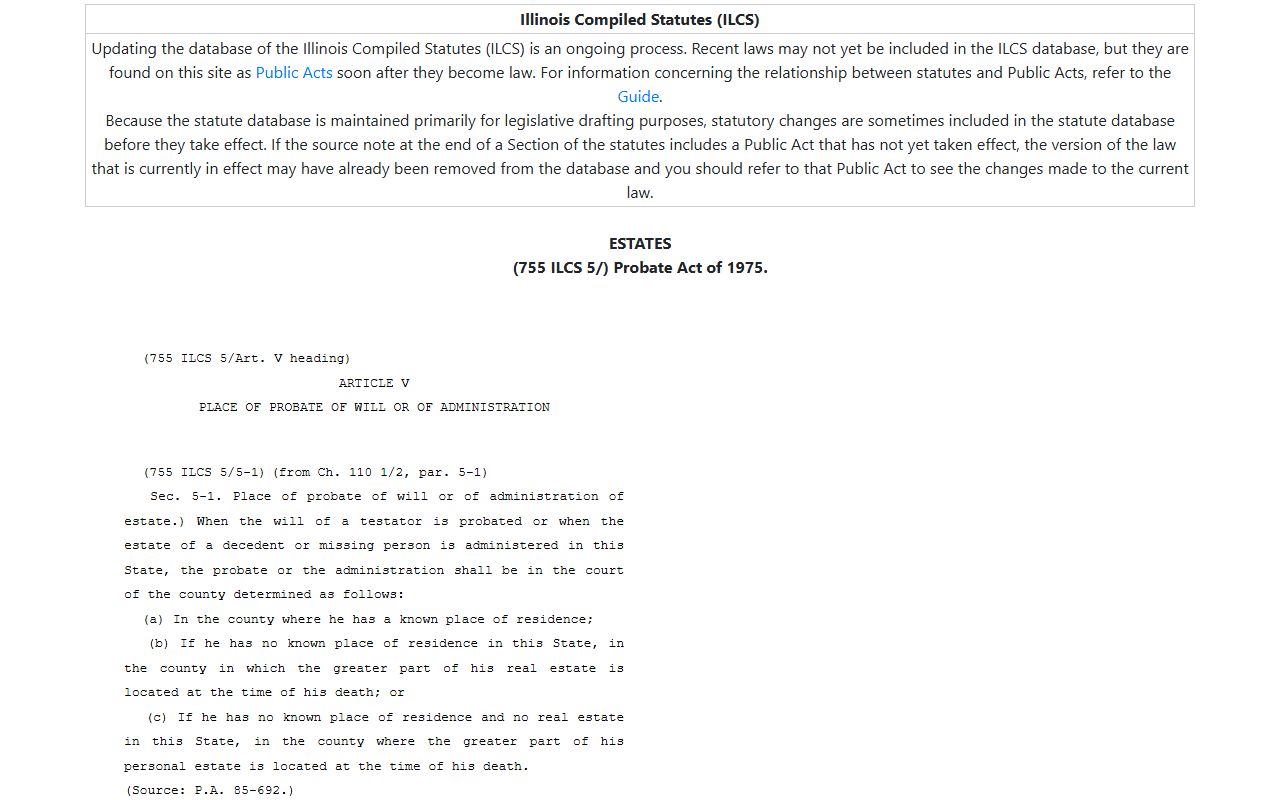 The statute screenshot above shows the venue ladder in the order the court applies it.
For a St. Clair County resident who passes away, the case belongs in the St. Clair County Circuit Court. The petition is filed with the Circuit Clerk in Belleville. If a person owned real estate in St. Clair County but lived elsewhere in Illinois, venue follows the residence rule first. A petition filed in the wrong county can be transferred, but a clean filing in the right county avoids delay.
Out-of-state residents with St. Clair County property sometimes still need an Illinois probate. Ancillary probate covers that path. The local case follows the same statute, the same case code PR, and the same Circuit Clerk filing routine.
Small Estate Affidavit Under 755 ILCS 5/25-1
Not every estate needs a full PR case. 755 ILCS 5/25-1 lets a person collect personal property by a small estate affidavit when the value of the personal estate is limited to $150,000, no letters of office are outstanding in Illinois, and no probate petition is pending or contemplated in any jurisdiction. The affidavit is sworn to under oath. It lists the heirs, the known debts, and the property to be transferred.  The statute screenshot above sets out the small estate cap and the conditions for using the affidavit.
If a small estate affidavit fits the facts, the family avoids a court case in St. Clair County altogether. There is no PR case to search because no petition is filed. Banks, brokers, and motor vehicle agencies accept the sworn affidavit and release the asset. The signer takes on personal liability for paying valid claims out of what is collected.
The affidavit does not work for real estate. It also does not work when claims exceed the assets in a way that needs court-supervised priority. In those cases the family files a full PR case with the Circuit Clerk. The choice between the two paths is the first decision a family or attorney makes after a death.
Common St. Clair County Probate Records
A St. Clair County probate file builds up document by document over the life of the estate. Some filings happen at the start. Others get added each year an estate stays open. The Circuit Clerk's docket lists each filing in date order, and the underlying papers can be ordered through the Copy Request form.
- Petition for probate of will or for letters of administration.
- Will, codicils, and proof of will.
- Oath and bond of the representative, or a bond waiver.
- Letters testamentary, letters of administration, or letters of office.
- Heirship affidavits and notices to heirs and legatees.
- Inventory of real and personal property.
- Claims, creditor notices, and publication proofs.
- Accountings, orders approving sale or distribution, final report, and discharge.
Guardianship cases under GR add their own filings. Common items include the guardianship petition, the physician's report for an adult ward, the guardian's oath, annual reports on the person, and accountings for any restricted account. The court records page lists the same Circuit Clerk forms library that holds blank probate templates by case type.
St. Clair County Probate Workflow
A typical St. Clair County probate case follows a set order. The path can stretch out for contested matters, but the basic steps repeat in most files. Knowing the flow helps a researcher read a docket and figure out where a case is in its life.
- Decide whether formal probate is needed. If the small estate affidavit fits, no PR case is filed.
- File in the county set by 755 ILCS 5/5-1. For a St. Clair County resident, that is the St. Clair County Circuit Court.
- File the petition, the will if there is one, proof of death, a proposed order, a bond or waiver, heirship materials, and the filing fee or fee waiver.
- Court issues letters if approved; the representative gives notices, publishes if required, gathers assets, handles claims, files an inventory and accountings, and asks for final discharge.
- Contested items such as will contests, guardianship disputes, real estate sales, creditor fights, or missing-heir issues stretch the timeline.
The Circuit Clerk does not give legal advice. The office accepts filings, posts dockets, and issues copies. A user who is not sure which path applies should talk with a probate attorney or a legal aid program before filing.
St. Clair County Probate Filing and Copy Fees
Probate filing fee amounts in St. Clair County are set by the Circuit Clerk fee book and adjusted by court order. The October 1, 2025 fee book is the current version published by the office. Specific probate filing tier amounts were not fully extracted into the research used to build this page, so the table below gives the items the fee book lists and the general copy and card fees that the Circuit Clerk publishes for every filing type.
| Item | Amount |
|---|---|
| Petition for probate or letters of office (PR) | Per Circuit Clerk fee book |
| Guardianship petition (GR) | Per Circuit Clerk fee book |
| Plain copy, first page | $2.00 starting fee |
| Plain copy, additional pages | Per Circuit Clerk copy fee chart |
| Certified copy | Per Circuit Clerk copy fee chart |
| Credit or debit card fee | 2.25%, minimum $1.00 |
For the current dollar amounts, check the Circuit Clerk page for the most recent fee book or call the office. The Circuit Clerk says a copy requester will be notified of the cost before the order is completed, and copies can be emailed or mailed.
Note: Fee amounts can change by court order, so confirm the current figure with the Circuit Clerk before filing a probate petition or ordering certified copies.
Guardianship and Restricted Probate Records
Probate records as a class are public, but several sub-areas are restricted. Guardianship files under GR can hold a physician's report, medical records, school records, and financial details that the court limits access to. The court can also seal portions of a probate file when minor children or sensitive medical information is involved. A request for a sealed item goes through a motion, not the Copy Request counter.
Juvenile matters are not probate but they share a confidentiality theme. The Juvenile Court Act of 1987 at 705 ILCS 405 restricts juvenile case access in a way that informs how courts treat minor wards in a GR case. 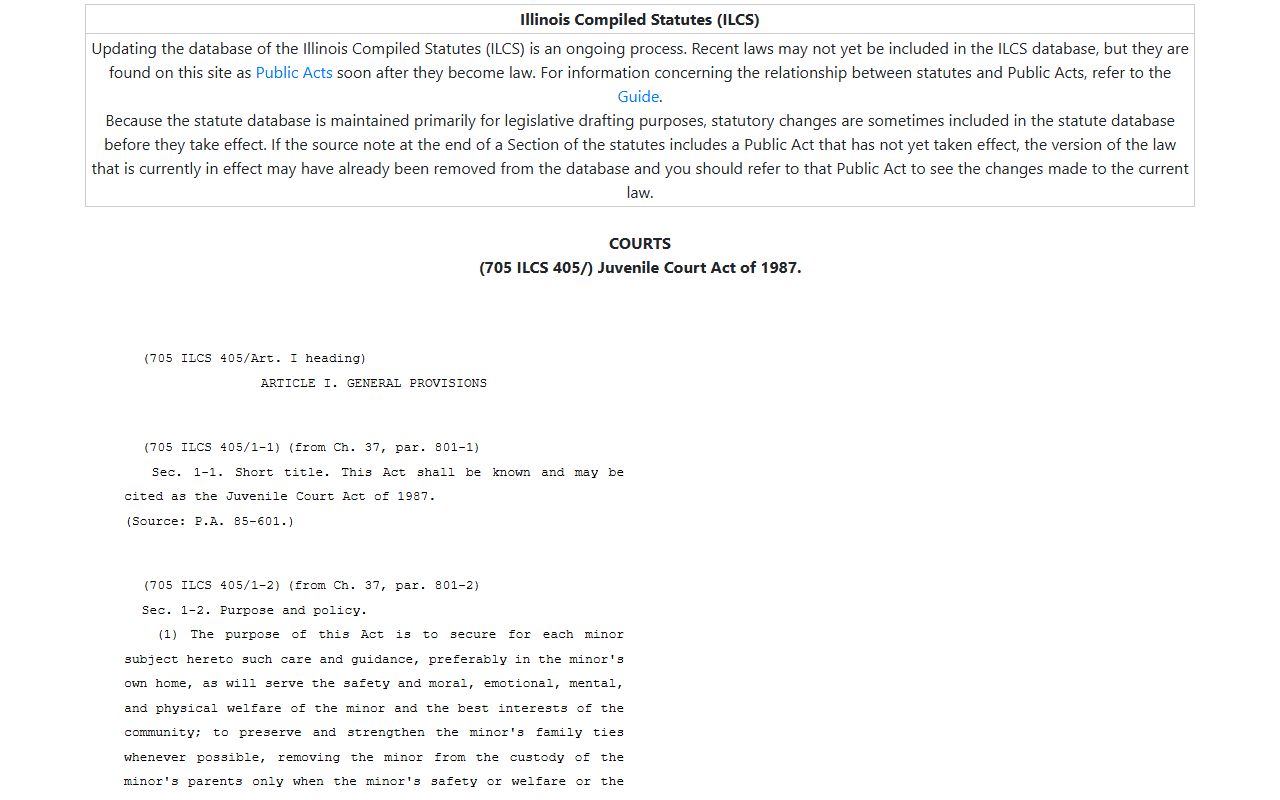 The statute screenshot above shows the confidentiality framework Illinois applies to juvenile court records.
Adoption is its own confidential track. Adoption files under the AD case category are impounded under 750 ILCS 50/18 and can be opened only by a specific court order. Probate sometimes touches adoption when an heirship question depends on a closed adoption decree. 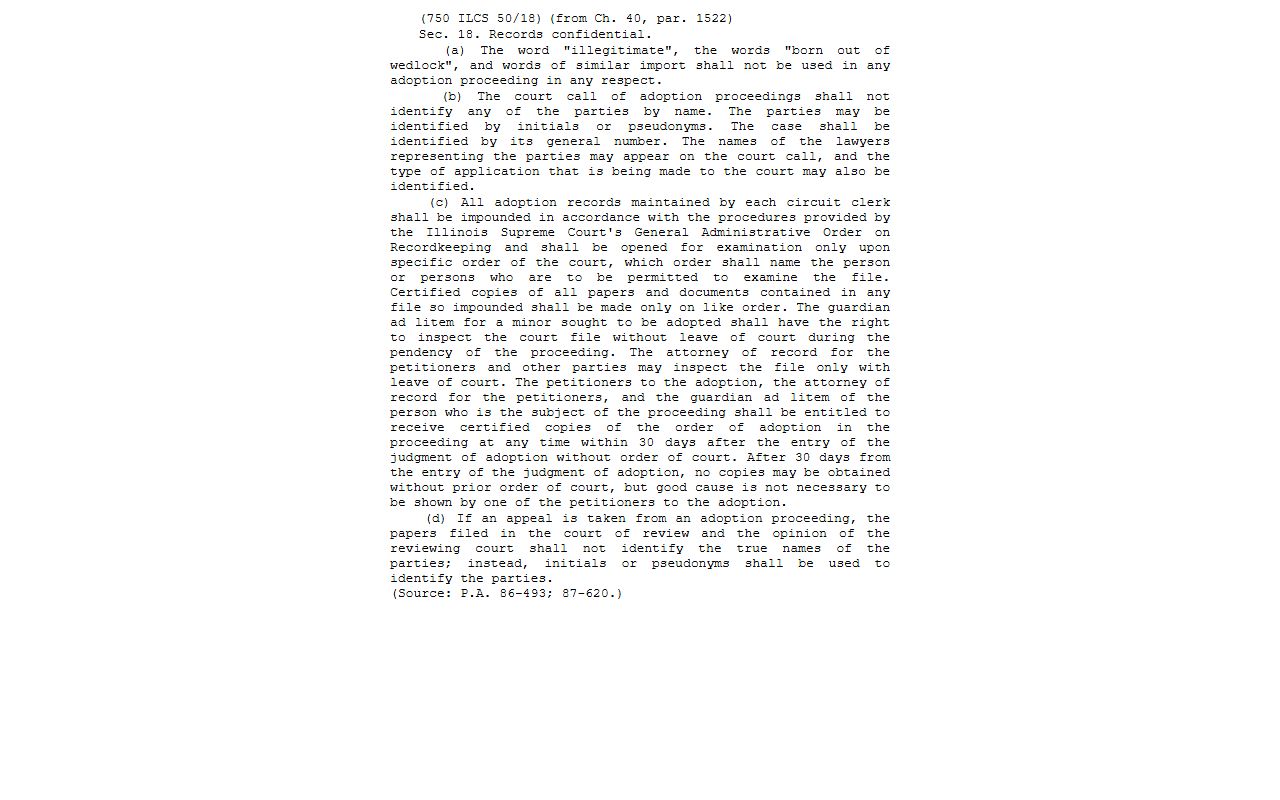 The statute screenshot above sets out the adoption record impoundment rule.
If a researcher hits a wall on access, the Circuit Clerk can confirm that a case exists and explain what is sealed. The full file content stays restricted until the court orders otherwise.
Probate Terms Defined
Probate uses a small set of Latin and old-English terms that show up over and over in case captions and docket entries. A short glossary helps a non-lawyer read a St. Clair County probate file.
- Testator
- The person who signed the will. A female testator is sometimes called the testatrix.
- Executor
- The person named in the will to carry out the estate. The court issues letters testamentary to the executor.
- Administrator
- The person appointed when no will exists or no executor can serve. The court issues letters of administration.
- Letters of Office
- The court order that gives an executor or administrator legal power to act for the estate.
- Heir
- A person who inherits under the law of intestate succession when there is no will, or by the will's own terms.
- Intestate
- The legal state of dying without a valid will. The Probate Act sets the order of who inherits.
Circuit Clerk Contact for Probate Filings
All St. Clair County probate filings go through the Circuit Clerk's office in Belleville. The counter handles new petitions, copy orders, fee payments, and questions about case status. Mail-in payments and forms use the office post office box.
St. Clair County Circuit Clerk
10 Public Square
Belleville, IL 62220
(618) 277-6600
Mon-Fri 8:00 a.m. - 4:30 p.m.
Mail: P.O. Box 691, Belleville, IL 62222