
How to Find St. Clair County Public Records
The St. Clair County records system is split. Court case files sit with the Circuit Clerk in Belleville. County administrative files sit with the County Clerk, the Sheriff, the State's Attorney, the Treasurer, the Recorder, and other elected offices. A search for a court case starts at the Circuit Clerk Court Record Search. A search for a marriage license, a tax-redemption parcel, an election filing, or a Sheriff incident report starts at a different door.
The fastest way to find the right record is to name what you want. A criminal case file is a court record. An arrest or incident report is a Sheriff record. A marriage certificate is a County Clerk record. A jury list, a board minute, or an office budget line is usually a FOIA record at whichever office holds it. Once the record type is clear, the office is clear, and the request route follows from there.
Many users start with the wrong office. A FOIA letter to the Circuit Clerk for a case file is usually redirected to the Circuit Clerk Copy Request. A copy request to the County Clerk for a court order is usually redirected to the Circuit Clerk. Sending the request to the right office on the first try saves time and avoids fee confusion.
Illinois FOIA Framework
The Illinois Freedom of Information Act at 5 ILCS 140 sets the public-records rules for every St. Clair County office that counts as a public body. The Act starts from a presumption of access. A record held by a public body is open unless a listed exemption applies. The St. Clair County Clerk publishes a FOIA information sheet that mirrors the statute and lists fees and a contact officer. The Illinois FOIA statute page shows the controlling text. 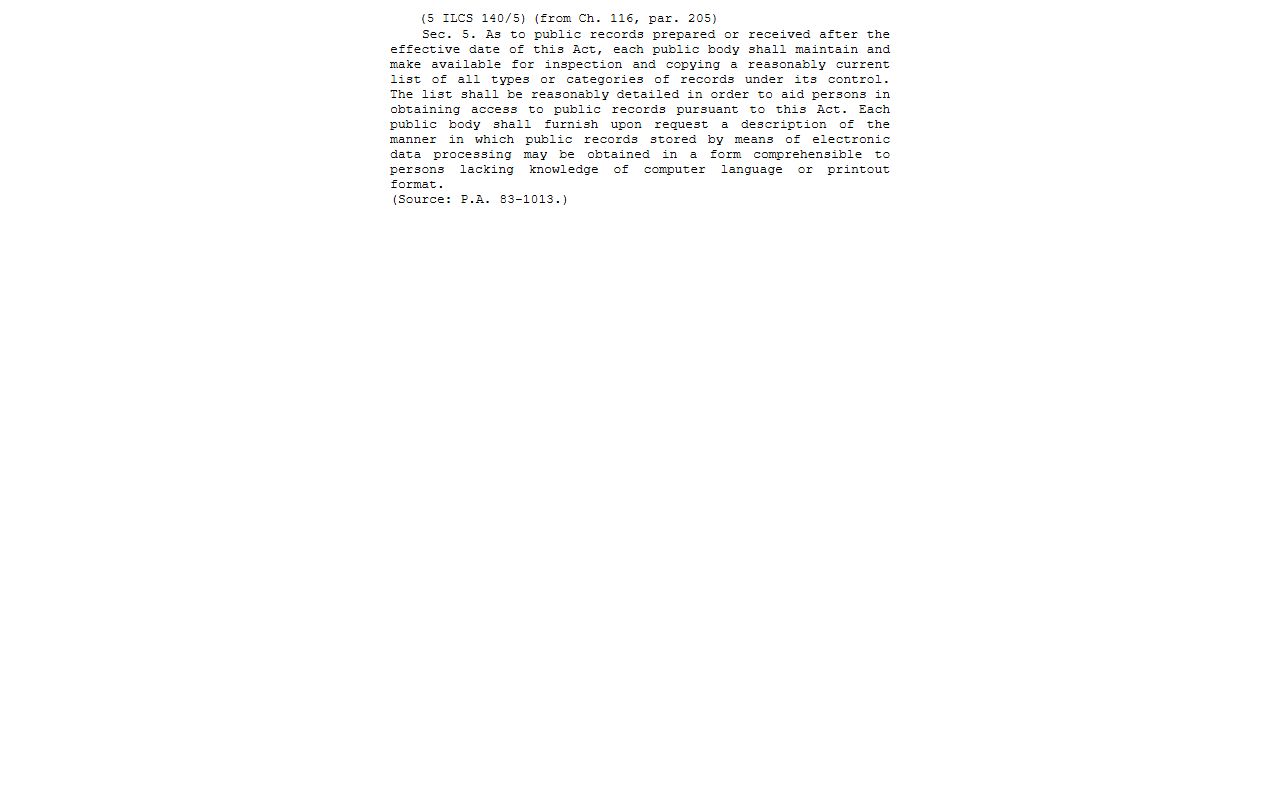 The statute page is the official source for FOIA rules that bind St. Clair County offices.
FOIA gives any person the right to ask for records. The requester does not need to live in Illinois. The requester does not need to give a reason. A request must reasonably describe the records sought. Some categories are exempt. Common exemptions cover personal-privacy information, law-enforcement work product in active cases, juvenile and minor information, trade secrets, and pre-decisional drafts.
The response clock is short. A public body must respond within 5 business days of receipt. The office may extend by 5 business days for a stated reason such as volume, the need to consult outside the office, or the need to redact. A commercial requester gets a longer track. If a request is denied, the requester may seek review from the Illinois Public Access Counselor in the Attorney General's office, or file suit in circuit court.
Note: A record open under FOIA at the office counter can still be redacted before release if it contains exempt personal identifiers or active-investigation content.
Court Records vs Administrative Records
The line between court records and administrative records matters in St. Clair County. The two tracks use different request forms, different fees, and different statutes. A request sent to the wrong track is slow and may be returned. The table below maps the split.
| Type of Record | Who Holds It | How to Request | Governing Law |
|---|---|---|---|
| Court case file (civil, criminal, family, probate, traffic) | St. Clair County Circuit Clerk | Circuit Clerk Copy Request form, in person or online | Illinois Supreme Court rules and case-specific statutes |
| Marriage license, birth, death, civil union | St. Clair County Clerk | Vital record request form, mail or in person; VitalChek for online | Illinois Vital Records Act and 750 ILCS 5 |
| Tax redemption, election filing, economic-interest statement | St. Clair County Clerk | County Clerk counter or online tax-redemption search | Illinois Property Tax Code and Election Code |
| Arrest report, incident report, jail roster | St. Clair County Sheriff | FOIA letter to the Sheriff FOIA officer, or online inmate lookup | 5 ILCS 140 and Illinois Criminal Code |
| State's Attorney administrative records | St. Clair County State's Attorney | FOIA letter to the State's Attorney FOIA officer | 5 ILCS 140 |
| County board minutes, budgets, contracts | County Clerk or department holding the file | FOIA letter to the relevant FOIA officer | 5 ILCS 140 and Open Meetings Act |
Court files are not pulled through FOIA. The Circuit Clerk handles court files through the Copy Request process. A FOIA letter to the Circuit Clerk for case documents is usually redirected to that form. Administrative files held by the Circuit Clerk as an office, such as office budgets or staffing rosters, are still FOIA records.
St. Clair County Clerk Records
The County Clerk is the main administrative-records office in St. Clair County. Thomas Holbrook holds the office. He was appointed in 2013, elected in 2014, and re-elected in 2018. The County Clerk is separate from the Circuit Clerk. The County Clerk does not hold court case files. The County Clerk does hold marriage licenses, birth records, death records, civil-union records, assumed-name filings, election filings, economic-interest statements, tax-redemption records, raffle and special-event licenses, and other county filings. The County Clerk's elected-official profile is published on the county site. 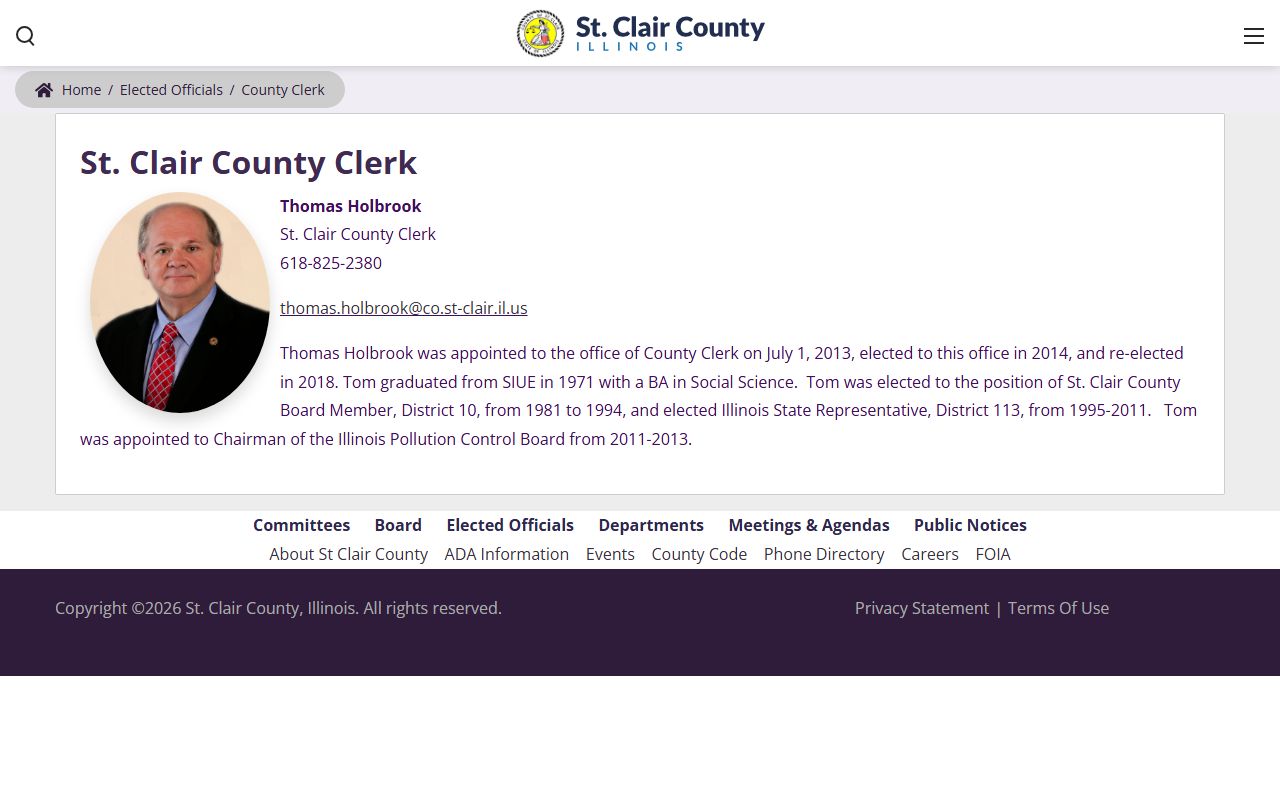 The profile shows the County Clerk's office contact, hours, and main duties. The full page lives on the county site at stclaircountyil.gov.
Vital records have their own request form. Birth, death, marriage, and civil-union records use the County Clerk Vital Record Request form. Online orders run through VitalChek, the only internet vendor the County Clerk approves. The County Clerk warns users about other online vendors that may charge fees without state approval. For mail orders, the County Clerk accepts money orders and cashier's checks. The office does not take personal checks. Birth and marriage records in St. Clair County go back unusually far. The County Clerk reports marriage records on file from 1763 to the present.
The tax-redemption search is a separate County Clerk product. Tax-buyer and parcel data live on a county portal hosted at stclairil.devnetwedge.com. 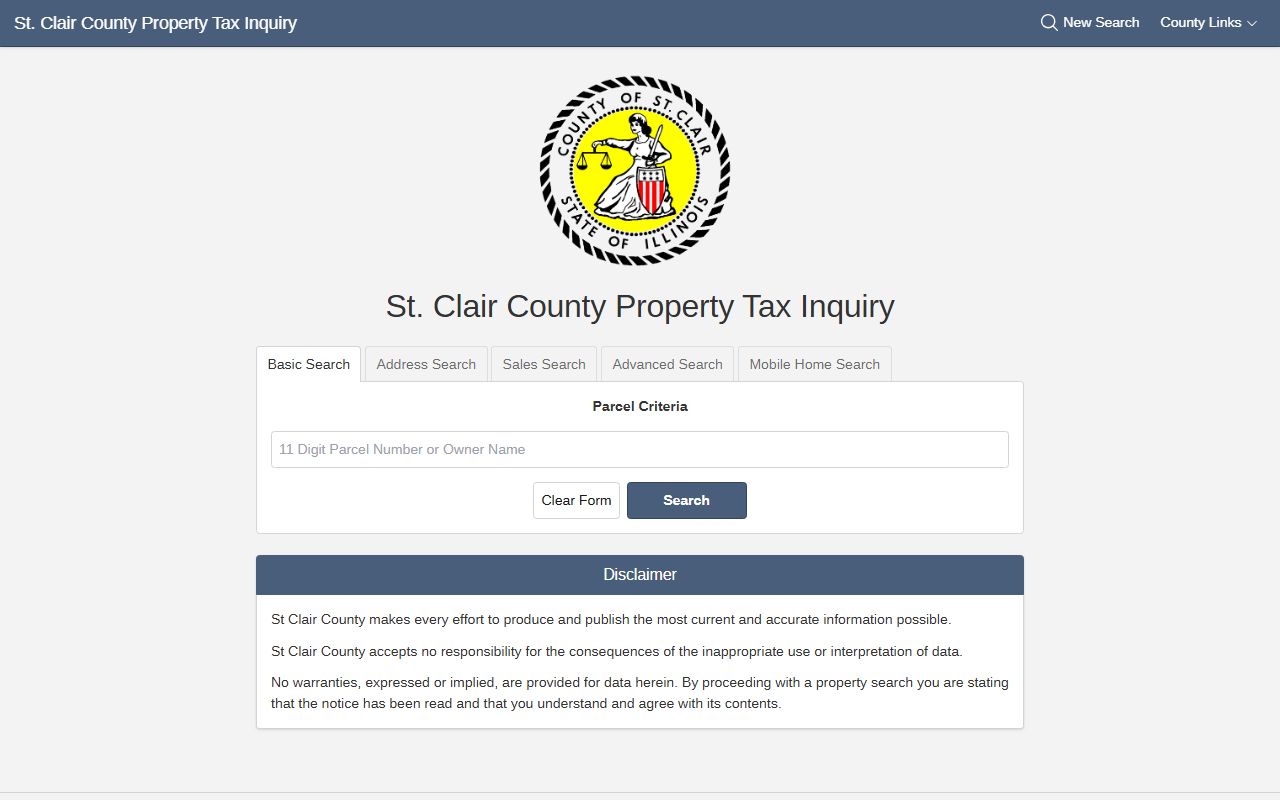 The tax-redemption portal lets a user look up parcels in tax sale and shows redemption status. The portal is open to the public and feeds the County Clerk Tax Extension Department.
FOIA requests to the County Clerk follow the standard Illinois rule. The County Clerk publishes a FOIA information sheet. Copy fees for FOIA records held by the County Clerk follow the statutory cap. The first 50 pages of black-and-white letter or legal copies are free. Pages after that cost 15 cents each. Color and oversize copies are billed at actual cost. Electronic media is billed at actual media cost. Certified copies add $1 per certified document.
- Marriage license applications and certified marriage records.
- Birth, death, and civil-union records held in the local file.
- Election filings, candidate filings, and economic-interest statements.
- Tax-redemption search, tax-sale records, and tax-extension data.
- Assumed-name (DBA) filings and notary public commissions.
- Raffle licenses, special-event licenses, and fireworks permits.
St. Clair County Circuit Clerk Records
Court case files in St. Clair County are kept by the Circuit Clerk. Kinnis Williams Sr. holds the office. The Circuit Clerk maintains the official court record for all civil and criminal cases under the 20th Judicial Circuit. Documents in the file are pulled through the Copy Request form, not through FOIA. The full case search and copy details are on the Circuit Clerk page, and a deeper breakdown of case categories is on the court records page.
Plain copies from the Circuit Clerk start at $2.00 for one page and rise by page count. Certified copies cost more. Card payments add a 2.25% fee with a $1.00 minimum. The Circuit Clerk does not accept personal checks. The office does accept cash, money orders, business checks, and credit or debit cards. Mail payments go to P.O. Box 691, Belleville, IL 62222.
Sheriff Records and Public Access
The St. Clair County Sheriff's Department holds incident reports, arrest reports, jail records, and a public inmate lookup. The Sheriff is Richard "Rick" Watson. The department sits at 700 N. 5th St. in Belleville. The non-emergency line is (618) 277-3505 and the jail line is (618) 456-7606. Arrest reports and incident reports are usually pulled through a FOIA letter to the Sheriff FOIA officer. Active-investigation content is often redacted under 5 ILCS 140/7. The redaction rule does not change the right to ask.
The public jail roster is a separate access route. The roster does not need a FOIA letter. It is a live online lookup that the Sheriff updates throughout the day. The roster covers current jail inmates only. Released and historical inmate searches use a different path, covered on the inmate records page. Sex offender lookups run through a separate state-level registry rather than the county jail roster.
Important: The Sheriff's inmate lookup is current custody only. A name missing from the roster is not proof a person was never booked; older bookings sit in archived records and may need a FOIA request to surface.
State's Attorney Records
The St. Clair County State's Attorney is James Gomric. The office sits at #10 Public Square in Belleville and runs from 8:30 a.m. to 4:30 p.m. weekdays. Case-related charging documents and dispositions live in the court file held by the Circuit Clerk. They are pulled through the Copy Request route. Administrative records of the State's Attorney office, such as office budgets, division staffing, FOIA logs, and policy documents, are open under FOIA. The office publishes a FOIA contact at (618) 277-3892 and accepts mail to #10 Public Square, Belleville, IL 62220.
Victim-related records have stricter rules. Victim names, addresses, and contact details are routinely redacted from public copies of police reports and prosecution files. The State's Attorney Victim Services Division handles victim notice and assistance, and those internal files are not open to a general public records request.
How to File a Public Records Request in St. Clair County
A public records request in St. Clair County is a short written letter. It does not have to be on a form. The letter must reach the FOIA officer for the right office. Many St. Clair County offices accept FOIA requests by email and by mail. A few offices accept hand-delivered requests at the counter during business hours. Keep a copy of the request and any proof of delivery.
- Identify the right office. Match the record to the County Clerk, Circuit Clerk, Sheriff, State's Attorney, Treasurer, Recorder, or department that holds the file. A wrong-office letter often gets returned with a redirect.
- Draft a short written request. List the records you want with enough detail that staff can find them. Name dates, parties, case numbers, or parcel numbers when you have them.
- Address the request to the office's FOIA officer. The County Clerk publishes a FOIA contact on the FOIA information sheet. The Sheriff and State's Attorney each publish FOIA contacts as well.
- Send the request by email or mail. Keep a date-stamped copy. The 5-business-day clock starts when the office receives the request, not when it was sent.
- Wait for the response. The office may grant, deny in part, deny in full, or extend by 5 business days for a stated reason. A commercial requester runs on a longer track.
- Pay any fees before pickup or release. Small FOIA productions are often free under the 50-page rule. Large or certified productions are billed before the office sends the file.
- If denied, ask for a review. The Illinois Public Access Counselor accepts review requests at the Attorney General's office. A court action under 5 ILCS 140/11 is also available.
Sample subject line for an email: "FOIA request - St. Clair County Clerk - tax-redemption records for parcel 08-25.0-300-014." A subject line that names the office and the record helps the FOIA officer route the file faster.
Public Records Contacts in St. Clair County
Two offices hold most of the day-to-day requests in St. Clair County: the County Clerk for vital, election, and tax records, and the Circuit Clerk for court case files. The contact blocks below cover both.
St. Clair County Clerk
Thomas Holbrook, County Clerk
10 Public Square
Belleville, IL 62220
(618) 825-2377
Mon-Fri 8:30 a.m. - 5:00 p.m.
CountyClerk@co.st-clair.il.us
St. Clair County Circuit Clerk
Kinnis Williams Sr., Circuit Clerk
10 Public Square
Belleville, IL 62220
(618) 277-6600
Mon-Fri 8:00 a.m. - 4:30 p.m.
CircuitClerk@co.st-clair.il.us
Fees for St. Clair County Public Records
St. Clair County public record fees split by office. The County Clerk follows the Illinois FOIA copy-fee cap. The Circuit Clerk follows a court copy-fee chart that starts higher because court copies often involve certified pages. Vital records have their own fixed fees set by the County Clerk vital-records page. The table below covers the common fees.
| Item | Amount |
|---|---|
| County Clerk FOIA, first 50 pages B&W letter/legal | Free |
| County Clerk FOIA, each page after the first 50 | $0.15 |
| County Clerk FOIA, color or oversize copies | Actual cost |
| County Clerk FOIA, electronic media | Actual media cost |
| County Clerk FOIA, certification add-on per document | $1.00 |
| Circuit Clerk plain copy, starting price for 1 page | $2.00 |
| Circuit Clerk card-payment fee | 2.25%, $1.00 minimum |
| First certified marriage record | $15.00 |
| First certified birth certificate | $15.00 |
| First certified death certificate | $20.00 |
| Assumed-name (DBA) filing | $20.00 |
A FOIA requester who does not want certified pages and does not need color or oversize prints often pays nothing for a small request. The 50-page free tier covers most one-record or one-meeting requests. A large or certified production is billed before release. The office tells the requester the price first.
Records That Are Restricted
Some St. Clair County records are not open to the public. The limits come from statute, court rule, or court order. A FOIA request for a restricted record can be denied in part or in full. The denial must cite the exemption used. The requester may ask the Public Access Counselor to review the denial.
- Juvenile court files and juvenile law-enforcement records under 705 ILCS 405. Public access is limited to parties, counsel, named agencies, and people who get a court order.
- Adoption files under 750 ILCS 50/18. The Circuit Clerk impounds adoption records and opens them only by a specific court order naming who may view the file.
- Sealed and expunged criminal records under 20 ILCS 2630/5.2. Once sealed, the office responds to an unauthorized inquiry as if no record exists, subject to narrow statutory exceptions.
- Mental-health case files in the MH category. The records contain protected health and capacity information.
- Personal identifiers in any file. Social Security numbers, financial account numbers, dates of birth, minor names, and medical details are routinely redacted.
- Active law-enforcement work product. Witness statements, ongoing surveillance details, and informant information may be withheld while a case is open.
- Orders of protection and safety-sensitive details. Protected addresses, firearm-related details, and victim contact details are commonly redacted.
Restricted does not always mean secret. Many restricted files are open to a narrow group, such as the parties, counsel, or a court-authorized requester. A person locked out by a routine FOIA route may still get the record through a court motion or a statutory access request.