
How to Find St. Clair County Marriage Records
Marriage records for couples married in St. Clair County are held by the County Clerk. The vital-records counter at 10 Public Square issues certified copies on request. The County Clerk page says the office maintains marriage records from 1763 to the present, which makes the office the only routing point for certified marriage copies in the county.
Apply by writing in or walking in. The clerk's office asks for the bride's maiden name, the groom's name, and the date of marriage. A first certified copy is $15.00. Each added copy on the same order is $8.00. Mail payments must be a money order or cashier's check. Personal checks are not taken. Cash is not accepted by mail. Online ordering runs only through VitalChek, the County Clerk's one approved internet vendor, which charges its own added fee. The County Clerk does not take credit cards or direct online orders at the counter.
The lead-in for any marriage search is the County Clerk vital-records page, which lists the record types, fees, and required information for each category.
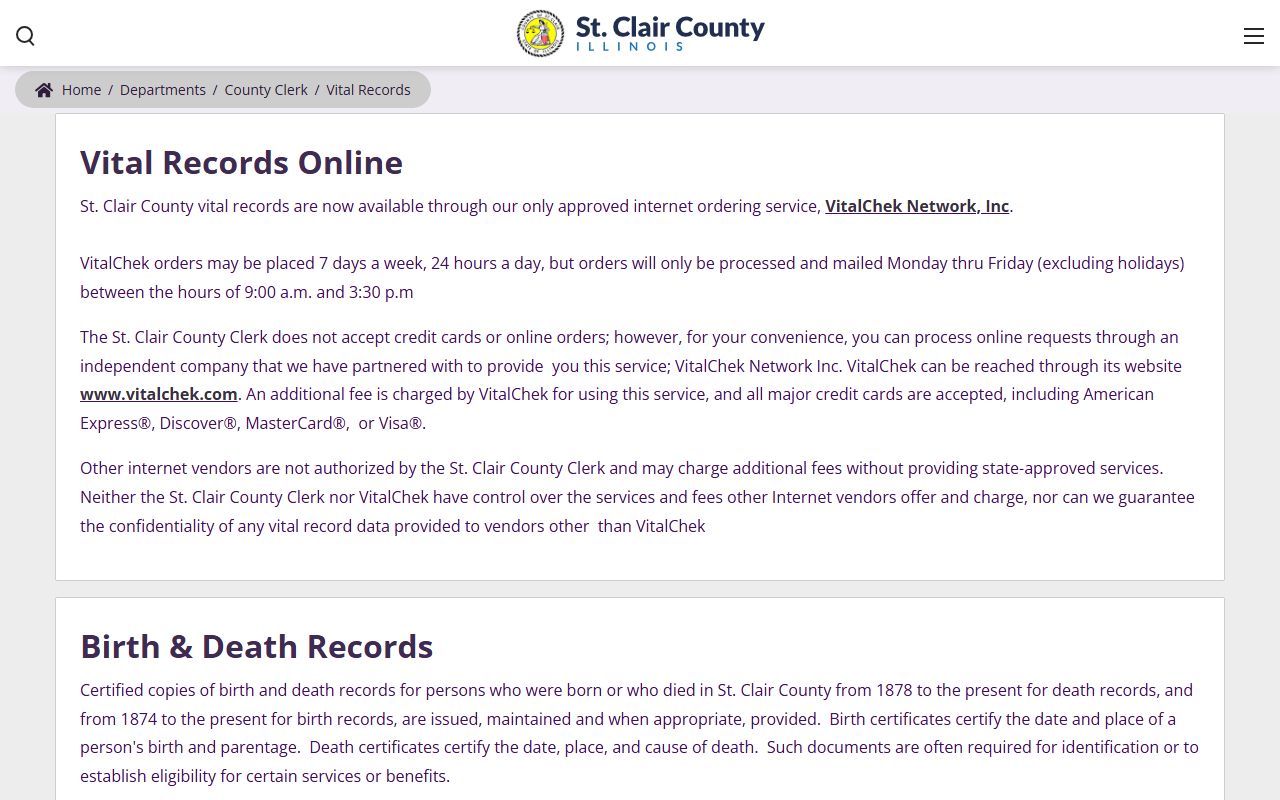
The vital-records page is the source for the marriage record fee tiers, the civil union record tiers, and the required information used at the counter. It is also where the office spells out the VitalChek-only policy for credit card orders.
Applying for a St. Clair County Marriage License
Marriage licenses are issued in person by the County Clerk. Both applicants must show up at the counter together. Application hours run 9:00 a.m. to 4:30 p.m. Monday through Friday. The license fee is $45.00. The license is good for use in St. Clair County only. A license issued here cannot be used to marry in a different Illinois county.
State rules set the basic terms. Each party must be 18 when the license is effective, or age 16 with both parents or a legal guardian consenting, or with judicial approval. A consenting parent or guardian must appear before the County Clerk in the minor's county of residence, or before a notary, and sign an affidavit that names both parties and gives their dates of birth. Proof of age, parenthood, and legal guardianship may be asked for. Blood tests are not required.
The license is effective one day after issuance. It is void if not used within 60 days. The marriage must be performed in the county where the license was issued. Two forms of identification are required from each applicant; at least one must be a photo ID such as a driver's license, a state ID, a military ID, or a valid passport. If one or both applicants were divorced inside the past year, the clerk asks for a copy of the divorce decree at the counter.
The official write-up of these rules is on the County Clerk get-married page, which also covers the courthouse ceremony.
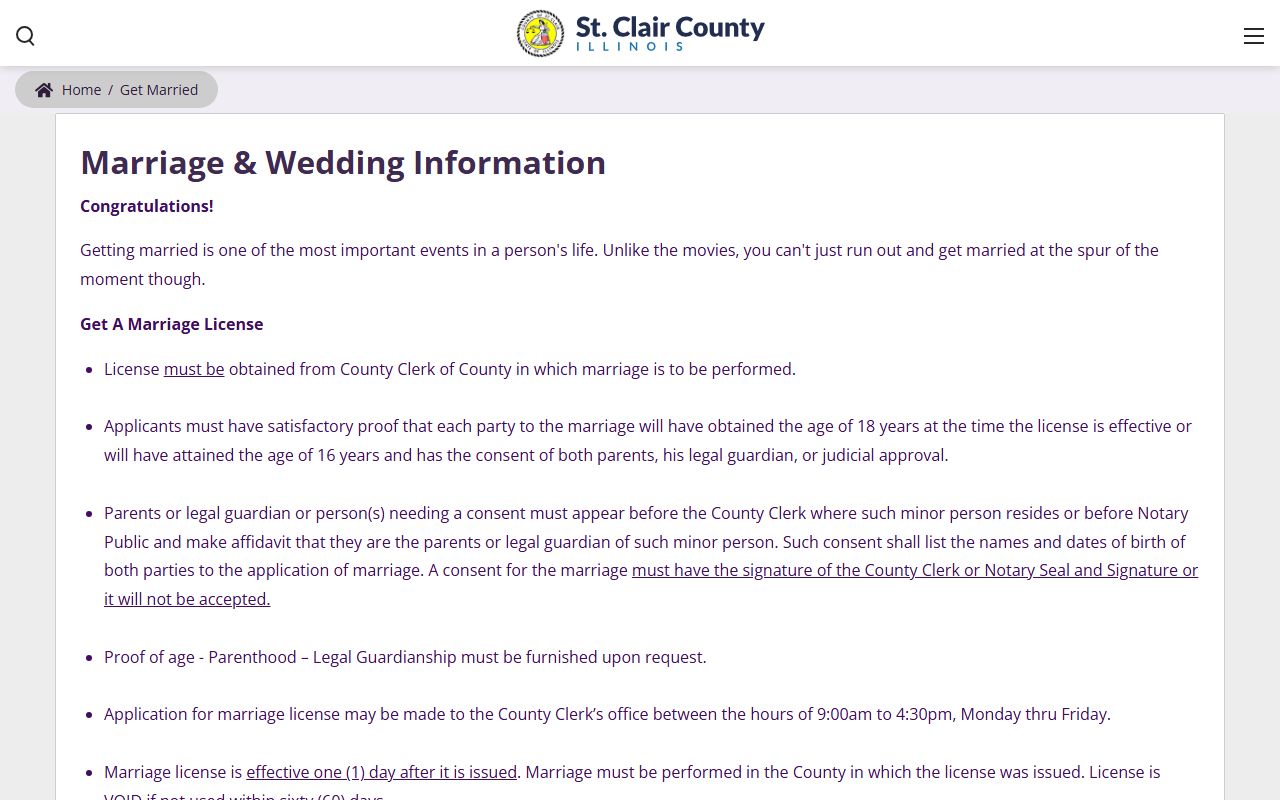
The get-married page is where the $45 license fee, the one-day waiting rule, the 60-day expiration, and the divorce-decree note all come from.
Courthouse Weddings at the St. Clair County Courthouse
Couples can marry at the courthouse Monday through Friday at 1:15 p.m. The ceremony has happened in this format since January 2, 2019. Bring the valid marriage license issued by the County Clerk, plus $10.00 in exact change for the marriage fee. The ceremony takes place in the Law Library conference room on the first floor. A court clerk handles the paperwork after the judge performs the marriage.
Two witnesses age 18 or older must come with the couple. Weddings are taken in order of arrival. Couples who show up after 1:15 p.m. may not be married that day because of judges' trial schedules and other duties. No marriages are performed after 2:00 p.m. Judges may decline a ceremony if the parties do not show dress and attitude in line with the seriousness of the marriage contract.
Note: The $10 courthouse ceremony fee must be exact change; the court clerk's desk does not make change for the marriage fee.
Marriage License Application Field Inventory
The marriage license application is taken in person, not online. Both applicants give the same set of items at the counter. The table below lines up with the requirements listed by the County Clerk and the official get-married page so applicants can prep before walking in.
| Field / Item | Type | Required | Notes |
|---|---|---|---|
| Applicant 1 identity | In-person proof | Yes | Two IDs; one must be photo ID (driver's license, state ID, military ID, or valid passport). |
| Applicant 2 identity | In-person proof | Yes | Two IDs; one must be photo ID. |
| Age proof | Document | Yes / on request | Must show age 18, or qualifying minor consent and judicial approval if 16. |
| Divorce decree | Document | Conditional | Required if either party was divorced in the past year. |
| Consent affidavit | Notarized or County Clerk affidavit | Conditional | For a 16-year-old applicant with parental or legal guardian consent. |
| License fee | Payment | Yes | $45.00 paid at the counter. |
The field set is short for a reason. Illinois removed the old blood-test requirement, and the County Clerk does not pull court records during the application. The license either issues that day, after the staff checks the IDs and the affidavit, or it does not.
St. Clair County Vital Records Fee Schedule
The County Clerk publishes a single fee schedule that covers marriage, civil union, and related vital records. The first certified copy of any marriage or civil union record carries the higher fee. Each added copy on the same order is billed at the lower add-on rate.
| Item | Amount |
|---|---|
| Marriage license | $45.00 |
| Civil union license | $45.00 |
| Courthouse wedding ceremony | $10.00 exact change |
| First certified marriage record | $15.00 |
| Additional marriage record copy | $8.00 |
| First certified civil union record | $15.00 |
| Additional civil union copy | $8.00 |
| Assumed name filing | $20.00 |
| Notary public (by mail / in person) | $15.00 / $10.00 |
Divorce decree copies are not on this schedule. Those are handled by the Circuit Clerk under its own copy fee chart, since divorce files are court records and not vital records. The next section covers where to send a divorce records request.
Where St. Clair County Divorce Records Come From
Divorce is a Circuit Court matter, not a County Clerk vital-record matter. The Circuit Clerk holds the divorce case file, the court dates, the orders, and the final judgment. A certified copy of a divorce decree must be requested from the Circuit Clerk copy-request process. The County Clerk vital-records counter does not issue divorce decrees.
The county uses two case category codes for divorce. DC is dissolution with children. DN is dissolution with no children. Both codes appear in case numbers held by the Circuit Clerk and on the public court record search. The case-category list is on the Circuit Clerk case types page, and the broader court file routing is covered on the St. Clair County court records page.
A divorce case file holds more than the final decree. It contains the petition, the response, any motions, the parenting plan or child support order, the property and maintenance order, and the judgment of dissolution. Some filings, such as financial affidavits and child related details, may be impounded or held back from public view by court order. A copy request marked certified is what most outside agencies will accept as proof of divorce.
Illinois Marriage and Dissolution of Marriage Act
Illinois divorces are governed by the Illinois Marriage and Dissolution of Marriage Act at 750 ILCS 5. The act covers residency, no-fault grounds, legal separation, invalidity of marriage, and related relief such as parenting allocation, child support, maintenance, and property division. Illinois is a no-fault state. The recognized ground for dissolution is irreconcilable differences.
Residency is a threshold question. The act requires that one spouse be a resident of Illinois at the time the action is filed and have been a resident for the required period before the court can enter a judgment of dissolution. The petition is filed in the circuit court of the county where one of the parties lives. For St. Clair County couples, that means filing with the Circuit Clerk in Belleville. The court also has authority to enter orders on parenting time, decision-making, support, and property at the same time the dissolution moves forward.
Note: No-fault is the only ground Illinois uses for dissolution; the old fault grounds were removed from the statute.
Filing for Divorce in St. Clair County
The Circuit Clerk handles divorce filings. eFiling is required for civil case types under Illinois Supreme Court Rule 9, with public eFiling terminals at the office for self-represented filers who need them. The forms library at the Circuit Clerk covers the Family case category and links to the Illinois Supreme Court standardized forms used statewide. The steps below match the path a self-represented filer takes through the system.
- Prepare the dissolution petition and the required statewide and county forms from the Family forms library.
- eFile through an approved provider, or use a public eFiling terminal at the Circuit Clerk, unless the case qualifies for a paper-filing exemption.
- Pay the filing fee at the time of filing, or file a fee waiver application asking the court to defer or waive the fee.
- Serve the other spouse with the summons and petition through the sheriff, a special process server, or another permitted method.
- Attend case management and status dates set by the court, including any required parenting education.
- Resolve parenting time, decision-making, child support, maintenance, and property division by agreement or by hearing.
- Obtain the judgment of dissolution, signed by the judge and filed with the Circuit Clerk.
Filers can request certified copies of the judgment from the Circuit Clerk after entry. A judgment may be needed for a name change record, a new marriage license, or a benefits claim. The Circuit Clerk counter is the single source for certified divorce documents in St. Clair County.
Civil Union Records in St. Clair County
Civil union records are kept by the County Clerk on the same fee tier as marriage records. A civil union license is $45.00, the same as a marriage license. The first certified copy of a civil union record is $15.00, and each added copy on the same order is $8.00. Applicants apply in person and can request records by writing in or walking in.
The vital-records page sets the same documentary rules for civil union records as for marriage records. Mail payments must be money order or cashier's check. Online orders run through VitalChek only. Walk-in pickups go through the same counter at 10 Public Square.
Where to Get Help with a St. Clair County Divorce
Self-represented filers have free statewide help. Illinois Legal Aid Online publishes guided interviews for dissolution with and without children, fee waiver applications, parenting plans, and child support worksheets. The site also covers orders of protection, name changes, and post-judgment changes. Most of the forms it produces are accepted by Illinois circuit courts, including the St. Clair County Circuit Clerk.
The site is the main routing point for free Illinois divorce forms and step-by-step interview tools used outside paid legal help.
Land of Lincoln Legal Aid is the legal aid provider for central and southern Illinois, which includes St. Clair County. The office screens for income eligibility and takes family, housing, public benefits, and consumer cases. Divorces with safety concerns, child support enforcement, and orders of protection are common case types. Intake runs through the regional office and the agency's hotline.
The Land of Lincoln site lists service areas and intake numbers used by St. Clair County residents who cannot afford a private attorney.